
CHRIST IN GENESIS | Lesson 4 | Lesson Notes / Talking Points
Read Genesis 4.1-25
‘CHRIST IN GENESIS’: MAKING THE CONNECTIONS & SETTING THE CONTEXT
1/ We have now come to chapter 4 of Genesis as we continue our quest for ‘CHRIST in Genesis.’ Pastor Alistair Begg has said: “The unity of the Bible lies in the fact that it is the one story, it is the one word of the one God concerning the one salvation that is found in the one Person of the Lord Jesus Christ.” We want to begin the Story searching for, discovering, seeing, and rejoicing in that truth.
2/ Chapter 4 concludes this opening section of the narrative, inspired by the Spirit of Christ Himself (1 Peter 1.11), originally intended to be read aloud, listening for the use, repetition, and sounds of the words, and receiving the warnings and encouragements that are conveyed in the message of the Story.
3/ This section began in ch 2.4 which describe the ‘the generations [toledot / tole-dah] of the heavens and the earth when they were created, in the day that the LORD God made the earth and the heavens.’ We have discussed what a ‘toledot’ is and how Genesis tells the story of these earliest ‘beginnings’ by compiling these ten historical ‘toledot’ accounts [see Lesson 2].
4/ So chapter 4 will describe in sordid account and detail what became of the heavens and earth that God had created so perfectly and innocently. We will begin to witness the horrible effects of the curse of sin that have so corrupted and degraded God’s creation immediately in that very first generation of fallen humans – and still continues to this day. See Romans 8.18-25.
5/ The contents of this first chapter will include: [1] The birth of the first children to Adam and Eve (1-2); [2] The offerings that Cain and Abel offered to God (3-7); [3] Cain’s murder of his brother, Abel (8); [4] God’s curse on Cain (9-15); [5] Cain’s rejection and departure from God’s Presence (16); [6] The earliest descendants and culture that came from Cain (17-24); [7] The birth of Seth to take the place of Abel (25); [8] The announcement of the godly seed beginning to call on the Name of the LORD (26). Of course, we won’t even try to deal with all the details that are related to all these events. We do want to stick with our intended theme: to show how CHRIST is promised, foretold, and typified in these events.
I / Historical-Redemptive Progression
1/ I know you may not be familiar with this term, but it is used prominently to describe one of the ways the Bible begins to point to Christ and prepare the world for His coming into our world to fulfill the purpose and plan God has had for the world and history even from before the beginning of it [see again Ephesians 1.9-10 & Colossians 1.20]. God knew where He was going – and what He was going to do – with the whole creation even before He created it: to glorify Himself and Christ through it all [Revelation 4.11]. He knew we would sin and corrupt His creation; but He also purposed to redeem us back to Himself through Christ. The Bible tells that story from the very beginning. ‘Historical-Redemptive Progression’ is one of the ways we read and interpret the whole story of the Bible … from Genesis to Revelation.
2/ Historical-Redemptive Progression simply means that in all the historical events that really happened to real people in real times, God is supernaturally and sovereignly working out the progression of His redemptive purposes – all to be fulfilled in Jesus Christ: both in His first coming into our world, and to be finally and fully consummated when He returns again at the end of this age.
3/ Nothing in the history of the world has ever happened by chance, accident, or haphazard, random occurrences. In every event of all history, God is sovereignly and supernaturally superintending it all to bring it to its ultimate fulfillment in Christ and the eventual New Creation.
II / New Testament Fulfillments and References
1/ So, coming back now to our immediate lesson text in Genesis 4, here’s how we’re going to look for the ‘CHRIST-markers’ in this chapter – and also in the lessons that will follow. We have the distinct advantage of being able to look for and see the ‘Historical-Redemptive Progression’ of Christ and the Gospel – even all the way to the New Creation – by looking back from the New Testament vantage point of its fulfillment in Christ. In other words, we read the Old Testament through New Testament eyes and lenses. Christ announced His fulfillment of all the Law and the Prophets [Matthew 5.17-18; Luke 24.25-27, 32, 44-46; et. al.]; and then His apostles wrote the rest of the New Testament to explain their understanding of the Old Testament Scriptures as the Holy Spirit gave them understanding and inspired them to write it for us.
2/ So what we will do is search the New Testament for references back to these Old Testament events. That will give us the Christ-centered Gospel interpretation for what took place with them – and how it all will advance the ‘Historical-Redemptive Progression’ of the coming of Christ and His Gospel.
III / v 1 / ‘I have gotten a man with the help of The LORD’
1/ Let’s begin with Eve’s excitement with the birth of first baby to be born into the fallen human race through the created processes of human reproduction. “Now Adam knew Eve his wife, and she conceived and bore Cain, saying, ‘I have gotten a man with the help of the LORD!’” First off, we can’t even begin to imagine what awe, wonder, and excitement she must have experienced with this very first human conception and childbirth. But, I’ll have to leave you to imagine that for yourself…
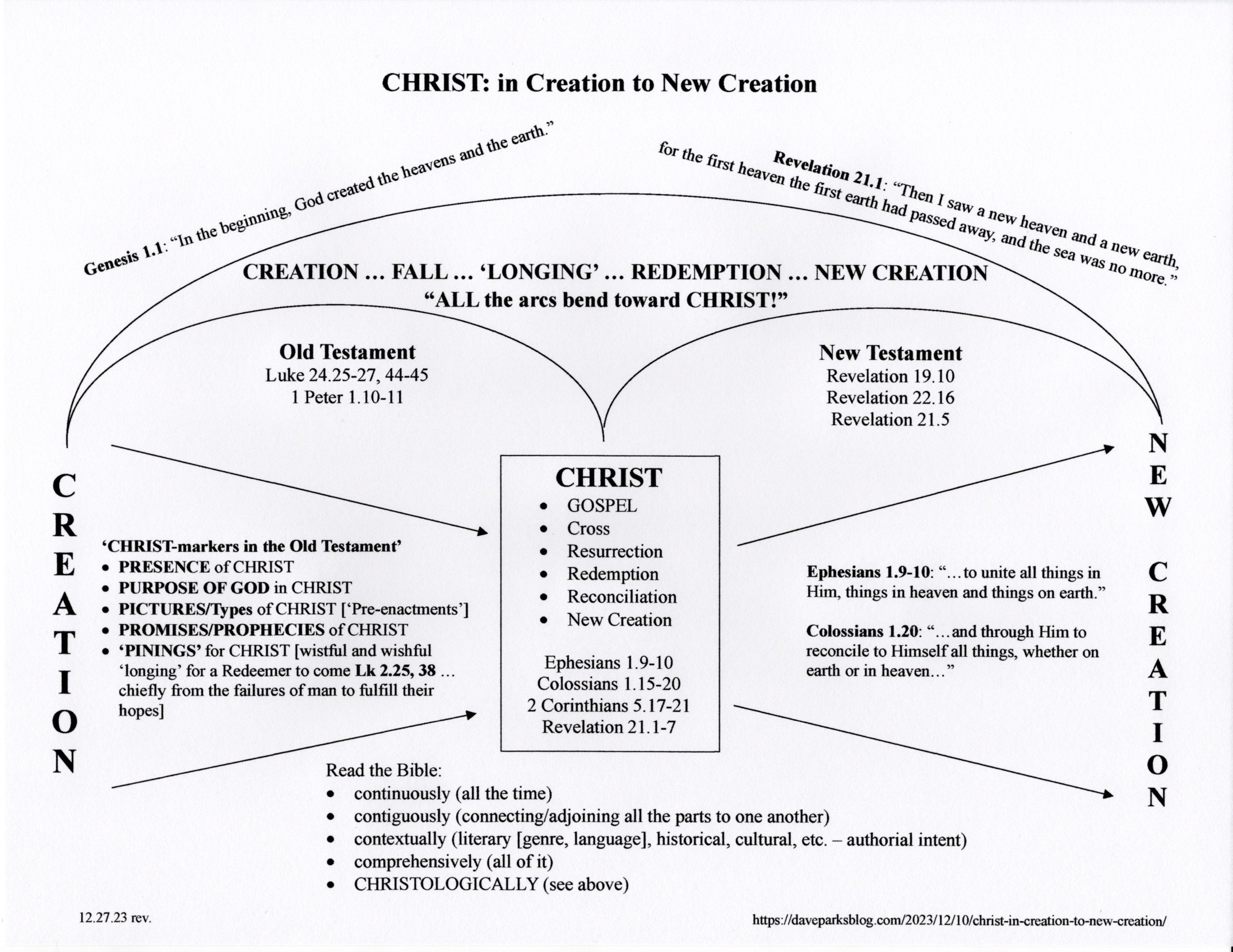
2/ Eve’s greater excitement had to be that she must have fully expected this first man-child to be the promised Redeemer God had promised back in ch 3.15: the ‘proto-evangelion’ or ‘first Gospel’ promise. God had promised that He would give a Redeemer who would come from the offspring of the woman – a Redeemer who would ‘bruise [crush] the head of the serpent’ and reverse the fatal effects of the curse He had pronounced upon them because of their sin. ‘Surely,’ Eve must have thought, ‘this is the promised Redeemer!’ If you consult the chart I have provided for you, CHRIST: in Creation to New Creation, you will find in the section on the left [‘CHRIST-markers in the Old Testament’] that the last ‘CHRIST-marker’ I have written is what I call: ‘PININGS’ for CHRIST [wistful and wishful ‘longing’ for a Redeemer to come…] That’s what this exclamation by Eve is: she is ‘PINING’ for the promised Redeemer!
3/ Going back to the end of ch 3.22-24, they had been expelled and driven out of Eden, their former Paradise. From that day to the birth of this first man-child, they had been ‘pining’ for the reversal of the curse they had brought upon themselves – haunted by the memories of ‘the way we were.’ “Mem’ries light the corners of my mind / Misty water-colored memories of the way we were / Scattered pictures of the smiles we left behind / Smiles we gave to one another for the way we were / Can it be that it was all so simple then / Or has time re-written every line? / If we had the chance to do it all again / Tell me, would we? Could we?” But, of course, they couldn’t do it all again – someone would have to come and do it all again for them…on their behalf. That One was the promised ‘seed of the woman’ whom God had promised who would be born of woman to redeem them from the curse of the law they had broken [Galatians 4.4-5]. So Eve could ‘pine’ and pin her hopes on her first baby boy, Cain, all she wanted to … but as we shall see, Cain was not the promised ‘seed of the woman’ Redeemer God had promised!
4/ BTW, those who would have heard this narrative read [as everyone did when it was first delivered], their ears would have picked up the similarities in the sounds of ‘Cain’ [qayin] and ‘gotten’ [qaniti].
IV / vv 2-7 / ‘And The LORD had regard for Abel and his offering…’
1/ Another man-child was born to Adam and Eve: Abel. Many Bible expositors speculate that Cain and Abel may have been twins since we are told only once that ‘she conceived’; then “And again, she bore his brother Abel.” But regardless, we now have two sons born to them. The first human siblings.
2/ Immediately, we are going to witness the separation and divergence of two ways of human thinking, believing, values, and conduct. Again, this goes back to ch 3.15 [God’s curse on the serpent and his descendants]: “I will put enmity between you and the woman, and between your offspring and her offspring.” It is imperative to note here that God has Divinely-appointed His Son as the ultimate ‘seed of the woman’ to come in the fullness of time to be the promised Redeemer. The Serpent is committed to killing the Redeemer – not only when He is born into the world – but also to kill all those who would be in His ancestral line of predecessors to bring Him into the world [Revelation 12.1-4].
- These two lines of human conduct will begin to form and diverge here in these two first sons. They will branch off into [1] the way of Abel’s descendants (Hebrews 11.4) – that is, the way of faith in God, obedience to God, worship of God, followers of God; and [2] the way of Cain’s descendants (Jude, v 11) – that is, the way of rebellion against God, enmity and warfare against God’s believers, and ultimate condemnation by God and separation from Him.
- Or, to put it another way: ‘The way of the Lamb’ versus ‘the way of the Dragon.’ The serpent and his descendants will come to be identified also as ‘the dragon’ as the Story of ‘historical-redemptive progression’ unfolds and develops [see Isaiah 27.1 & especially Revelation 12, 13, 16, and culminating in ch 20.2, “And he seized the dragon, that ancient serpent, who is the devil and Satan…”] So, from here on, the ‘seed of the serpent’ will be the same as ‘the way of the Dragon.’
- You need to see these two alliances at enmity with one another forming, fighting, and diverging here in Genesis 4. We will follow these two enemy warring lines all throughout Genesis – and even throughout the rest of the Scripture narrative and the historical-redemptive progression of the Gospel.
3/ Abel is a man of faith. He believes in the God-Creator he has learned about from his father, Adam, and he offers the sacrifices his father has taught him are acceptable to God. We know this because we read in Hebrews 11.4: By faith Abel offered to God a more acceptable sacrifice than Cain, through which he was commended as righteous, God commending him by accepting his gifts. And through his faith, though he died, he still speaks. NOTE: Abel was a believer and a man of faith before he offered the acceptable sacrifice. The ‘faith’ he exercised and obeyed was his belief in God he had learned from Adam.
4/ Cain, on the other hand, has allied himself with the spirit of the ‘way of the Dragon.’ He rejects what he knows to be the right offering that pleases God, and he offers the sacrifice that he himself chooses and produces. And the LORD had regard for Abel and his offering, but for Cain and his offering He had no regard. God looked, not only on their offerings, but first of all on their hearts. NOTE: God accepted Abel and his faith first…then his offering. The LORD had no regard for Cain and his rebellious spirit first…then rejected his offering. But Abel had borne witness to his faith…even to death! Rev. 2.10.
5/ This infuriated Cain. So Cain was very angry, and his face fell. The LORD had no right, authority, or prerogative to require him to offer any other offering than the one he chose to offer – and God should accept it. He was angry, and it showed, and he wanted everyone to know it – even God. The LORD intercepted Cain in mercy and reasoned with him: The LORD said to Cain, “Why are you angry, and why has your face fallen? If you do well, will you not be accepted? And if you do not do well, sin is crouching at the door. Its desire is contrary to you, but you must rule over it.” Cain’s sin, and ours, is depicted as a ravenous beast that is crouching to kill, destroy, and devour us [see 1 Peter 5.8]. But Cain is insistently and insolently rebellious against the will of God. He will not repent and do what he knows is the way of faith and righteousness. He has gone to ‘the dark side,’ the way of the serpent-dragon.
V / vv 8-15 / ‘We should not be like Cain, who was of the evil one…’
1/ Now we witness the first murder in the history of the human race, and the apostle John will tell us just who inspired Cain and instigated him to commit it against his brother Abel – and why. Cain seethed and stewed in his anger, bitterness, resentment, and yes, his wicked hatred toward his brother … he conspired and planned in his evil mind how he could and would murder him. ‘The way of Cain’ thinks and says: ‘If you disagree with me and live differently than I do in my rebellion against God, then you don’t deserve to live. I will kill you and rid you from our society and from the earth.’ This is the ultimate ‘cancel culture.’
2/ Cain spoke to Abel his brother. We can be sure this ‘speaking’ was in hatred, animosity, and antagonism … being red in the face and with his veins and arteries bulging. And when they were in the field, Cain rose up against his brother Abel and killed him. I’m going to interject the apostle John’s commentary on Cain’s motive and purpose here so we can keep it in mind as we go from here throughout the rest of human history: We should not be like Cain, who was of the evil one and murdered his brother. And why did he murder him? Because his own deeds were evil and his brother’s righteous. Do not be surprised, brothers, that the world hates you. / 1 John 3.12-13. When John says Cain was ‘of the evil one,’ he means: ‘from the evil one, belonging to the evil one, acting like the evil one.’ Cain had the spiritual DNA of the evil one in his heart and soul. And who was the evil one? He is the serpent who beguiled Eve to sin, and then went into the world to make war against the predecessors and offspring of the ‘seed of the woman’ from whom the Redeemer was promised to come. See Revelation 12.17 – this history-long hatred and warfare ‘of the evil one’ against Christ and His followers had its ‘genesis’ here with Cain’s murder of Abel. We continue to experience it as ‘spiritual warfare.’
3/ Jesus Himself said that Abel was the first martyr for the faith [Matthew 23.35; Luke 11.51]. Jesus also said that those who would kill Him were doing so from the same spiritual DNA of the dragon: You are of your father the devil [just as Cain was], and your will is to do your father’s desires. He was a murderer from the beginning… [John 8.44]. All of this history from Genesis to the Cross to the New Creation is summarized in Revelation 12. But the war was engaged here with Cain martyring his brother Abel.
4/ NOTE: Cain didn’t just kill another man as his descendant Lamech would six generations later [Genesis 6.23-24]. Cain murdered his ‘brother.’ That relationship is specifically reiterated seven times. We are commanded to love all others, but especially our ‘brothers.’ When Cain is confronted by the LORD, he denied any responsibility or culpability in what he had done: “Where is your brother?” He [Cain] said, “I do not know; am I my brother’s keeper?” This is the message John gives us in 1 John 3.11-15.
5/ Now we see another prominent ‘CHRIST-marker’ in the testimony of Abel’s blood. The LORD declares to Cain that his guilt is undeniable and inescapable because “The voice of your brother’s blood is crying to me from the ground. And now you are cursed from the ground, which has opened its mouth to receive your brother’s blood from your hand.” We all know what Abel’s blood was crying out for: justice, vengeance, retribution. And The LORD moves against Cain to avenge the blood of His faithful martyr … even though, in His common grace and mercy, that sentence will be mitigated [see vv 11-15].
6/ BUT, when Christ came and was murdered for the very same reasons [Matthew 23.29-36], His blood secures the forgiveness and justification even of those who put Him to death [which is, of course: all of us]. “Father, forgive them, for they know not what they do” / Luke 23.34. The promised Messianic ‘seed of the woman’ who would come would die to redeem the fallen offspring of Adam who would believe in Him. He would come to shed ‘the blood of the new covenant for the remission of our sins.’ And so, the Hebrews writer declares that we have NOT come to the mountain of the law and our self-worked righteousness, which can and will only condemn us in the guilt of our sins. BUT we have come to Mount Zion, the refuge of grace, “…and to Jesus, the mediator of a new covenant, and to the sprinkled blood that speaks a better word than the blood of Abel” [Hebrews 12.18-24].
VI / vv 16-26 / How ‘the rest of the story’ of the human race began…
1/ All we can do here is point out some prominent events that will serve as markers to direct us through the rest of Genesis, the Scripture narrative, and the history of the world … on to the end of the ‘historical-redemptive progression’ of Christ and the Gospel. See 1 Corinthians 15.20-28 & Revelation 20.10.
2/ v 16 / Then Cain went away from the Presence of the LORD and settled in the land of Nod, east of Eden. His descendants [‘the seed of the serpent’] also will establish and cultivate a culture of rebellion against The LORD and continue to wage a war of enmity against ‘the seed of the woman’–people of faith. [We will see them re-constitute after the flood in the descendants of Ham / Genesis 10.6-20; 11.1-9
3/ v 25 / And Adam knew his wife again, and she bore a son and called his name Seth, for she said, “God has appointed for me another offspring [seed] instead of Abel, for Cain killed him.” The enmity and warfare against the promised ‘seed of the woman’ will continue, but God’s redemptive purposes will prevail. The LORD provides another offspring of faith to bring in the Redeemer in the fullness of time [Luke 3.38]. “…in order that God’s purpose of election might continue…” [Romans 9.10].
4/ v 26 / At that time people began to call upon the Name of the LORD. Contrast with v 16. These two lines of ‘the seed of the serpent’ [rebellion against The LORD] and ‘the seed of the woman’ [faith in The LORD] now begin to, not only diverge from one another, but to declare themselves and act on their respective convictions. We’ll see in following lessons where it goes from here…


 ~Dave Parks