CHRIST: The Better ‘Word’ of His Blood [Hebrews 12.24]

CHRIST IN GENESIS | Lesson 4 | Lesson Notes / Talking Points

Read Genesis 4.1-25

‘CHRIST IN GENESIS’: MAKING THE CONNECTIONS & SETTING THE CONTEXT

1/ We have now come to chapter 4 of Genesis as we continue our quest for ‘CHRIST in Genesis.’ Pastor Alistair Begg has said: “The unity of the Bible lies in the fact that it is the one story, it is the one word of the one God concerning the one salvation that is found in the one Person of the Lord Jesus Christ.” We want to begin the Story searching for, discovering, seeing, and rejoicing in that truth.

2/ Chapter 4 concludes this opening section of the narrative, inspired by the Spirit of Christ Himself (1 Peter 1.11), originally intended to be read aloud, listening for the use, repetition, and sounds of the words, and receiving the warnings and encouragements that are conveyed in the message of the Story.

3/ This section began in ch 2.4 which describe the ‘the generations [toledot / tole-dah] of the heavens and the earth when they were created, in the day that the LORD God made the earth and the heavens.’ We have discussed what a ‘toledot’ is and how Genesis tells the story of these earliest ‘beginnings’ by compiling these ten historical ‘toledot’ accounts [see Lesson 2].

4/ So chapter 4 will describe in sordid account and detail what became of the heavens and earth that God had created so perfectly and innocently. We will begin to witness the horrible effects of the curse of sin that have so corrupted and degraded God’s creation immediately in that very first generation of fallen humans – and still continues to this day. See Romans 8.18-25.

5/ The contents of this first chapter will include: [1] The birth of the first children to Adam and Eve (1-2); [2] The offerings that Cain and Abel offered to God (3-7); [3] Cain’s murder of his brother, Abel (8); [4] God’s curse on Cain (9-15); [5] Cain’s rejection and departure from God’s Presence (16); [6] The earliest descendants and culture that came from Cain (17-24); [7] The birth of Seth to take the place of Abel (25); [8] The announcement of the godly seed beginning to call on the Name of the LORD (26). Of course, we won’t even try to deal with all the details that are related to all these events. We do want to stick with our intended theme: to show how CHRIST is promised, foretold, and typified in these events.   

I / Historical-Redemptive Progression

1/ I know you may not be familiar with this term, but it is used prominently to describe one of the ways the Bible begins to point to Christ and prepare the world for His coming into our world to fulfill the purpose and plan God has had for the world and history even from before the beginning of it [see again Ephesians 1.9-10 & Colossians 1.20]. God knew where He was going – and what He was going to do – with the whole creation even before He created it: to glorify Himself and Christ through it all [Revelation 4.11]. He knew we would sin and corrupt His creation; but He also purposed to redeem us back to Himself through Christ. The Bible tells that story from the very beginning. ‘Historical-Redemptive Progression’ is one of the ways we read and interpret the whole story of the Bible … from Genesis to Revelation.

2/ Historical-Redemptive Progression simply means that in all the historical events that really happened to real people in real times, God is supernaturally and sovereignly working out the progression of His redemptive purposes – all to be fulfilled in Jesus Christ: both in His first coming into our world, and to be finally and fully consummated when He returns again at the end of this age.

3/ Nothing in the history of the world has ever happened by chance, accident, or haphazard, random occurrences. In every event of all history, God is sovereignly and supernaturally superintending it all to bring it to its ultimate fulfillment in Christ and the eventual New Creation.

II / New Testament Fulfillments and References

1/ So, coming back now to our immediate lesson text in Genesis 4, here’s how we’re going to look for the ‘CHRIST-markers’ in this chapter – and also in the lessons that will follow. We have the distinct advantage of being able to look for and see the ‘Historical-Redemptive Progression’ of Christ and the Gospel – even all the way to the New Creation – by looking back from the New Testament vantage point of its fulfillment in Christ. In other words, we read the Old Testament through New Testament eyes and lenses. Christ announced His fulfillment of all the Law and the Prophets [Matthew 5.17-18; Luke 24.25-27, 32, 44-46; et. al.]; and then His apostles wrote the rest of the New Testament to explain their understanding of the Old Testament Scriptures as the Holy Spirit gave them understanding and inspired them to write it for us.

2/ So what we will do is search the New Testament for references back to these Old Testament events. That will give us the Christ-centered Gospel interpretation for what took place with them – and how it all will advance the ‘Historical-Redemptive Progression’ of the coming of Christ and His Gospel.

III / v 1 / ‘I have gotten a man with the help of The LORD’

1/ Let’s begin with Eve’s excitement with the birth of first baby to be born into the fallen human race through the created processes of human reproduction. “Now Adam knew Eve his wife, and she conceived and bore Cain, saying, ‘I have gotten a man with the help of the LORD!’” First off, we can’t even begin to imagine what awe, wonder, and excitement she must have experienced with this very first human conception and childbirth. But, I’ll have to leave you to imagine that for yourself…

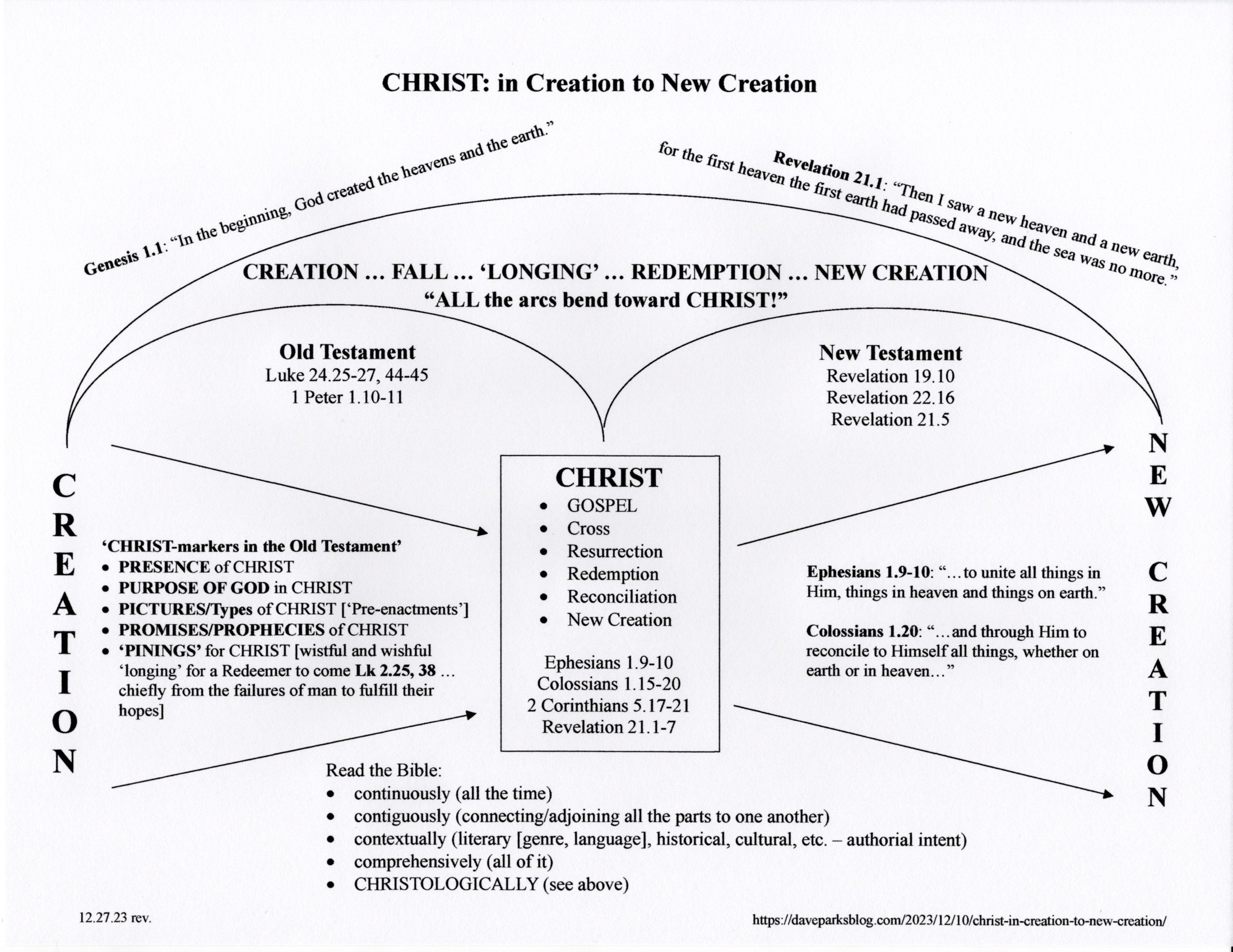
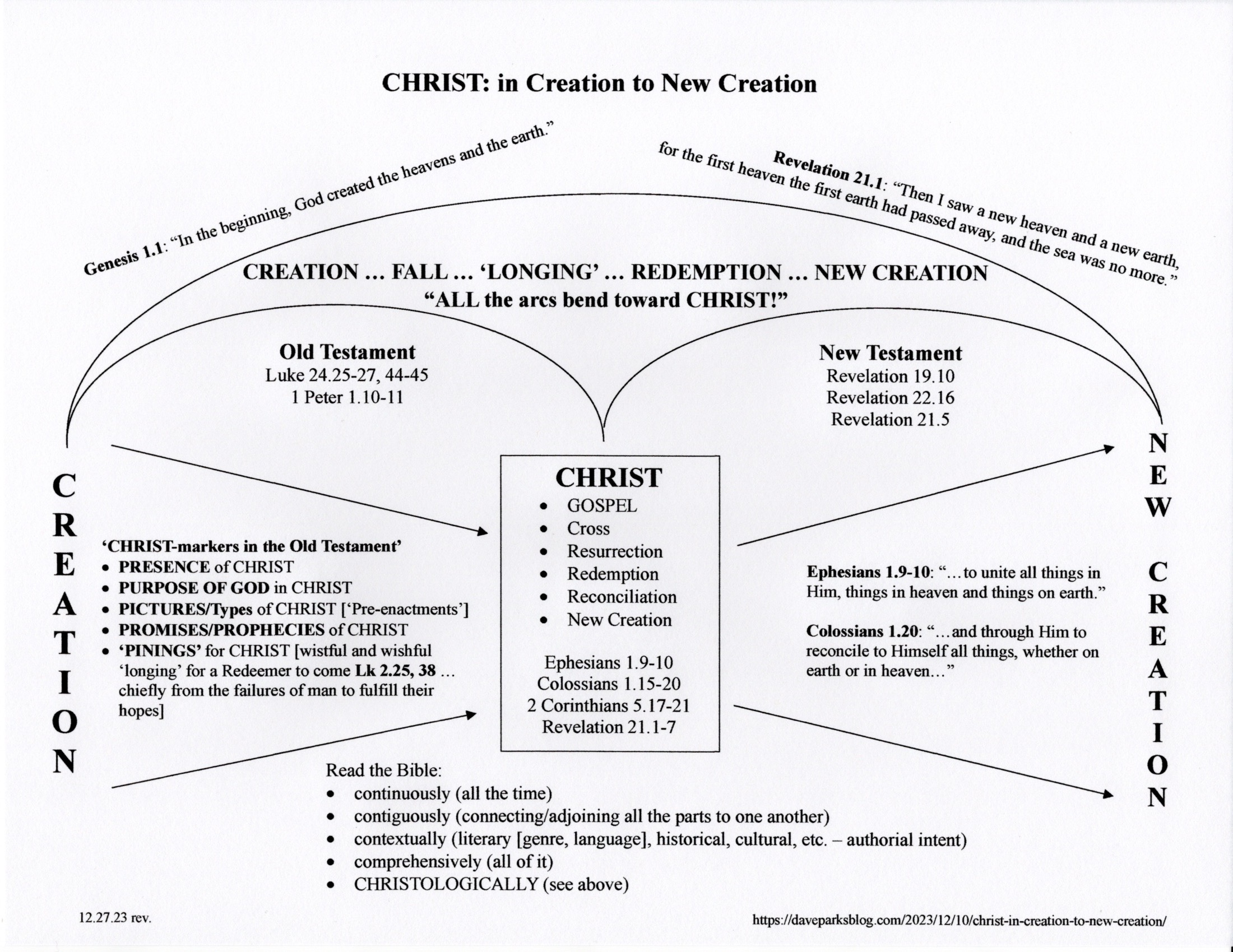
2/ Eve’s greater excitement had to be that she must have fully expected this first man-child to be the promised Redeemer God had promised back in ch 3.15: the ‘proto-evangelion’ or ‘first Gospel’ promise. God had promised that He would give a Redeemer who would come from the offspring of the woman – a Redeemer who would ‘bruise [crush] the head of the serpent’ and reverse the fatal effects of the curse He had pronounced upon them because of their sin. ‘Surely,’ Eve must have thought, ‘this is the promised Redeemer!’ If you consult the chart I have provided for you, CHRIST: in Creation to New Creation, you will find in the section on the left [‘CHRIST-markers in the Old Testament’] that the last ‘CHRIST-marker’ I have written is what I call: ‘PININGS’ for CHRIST [wistful and wishful ‘longing’ for a Redeemer to come…] That’s what this exclamation by Eve is: she is ‘PINING’ for the promised Redeemer!

3/ Going back to the end of ch 3.22-24, they had been expelled and driven out of Eden, their former Paradise. From that day to the birth of this first man-child, they had been ‘pining’ for the reversal of the curse they had brought upon themselves – haunted by the memories of ‘the way we were.’ “Mem’ries light the corners of my mind / Misty water-colored memories of the way we were / Scattered pictures of the smiles we left behind / Smiles we gave to one another for the way we were / Can it be that it was all so simple then / Or has time re-written every line? / If we had the chance to do it all again / Tell me, would we? Could we?” But, of course, they couldn’t do it all again – someone would have to come and do it all again for them…on their behalf. That One was the promised ‘seed of the woman’ whom God had promised who would be born of woman to redeem them from the curse of the law they had broken [Galatians 4.4-5]. So Eve could ‘pine’ and pin her hopes on her first baby boy, Cain, all she wanted to … but as we shall see, Cain was not the promised ‘seed of the woman’ Redeemer God had promised!

4/ BTW, those who would have heard this narrative read [as everyone did when it was first delivered], their ears would have picked up the similarities in the sounds of ‘Cain’ [qayin] and ‘gotten’ [qaniti].

IV / vv 2-7 / ‘And The LORD had regard for Abel and his offering…’

1/ Another man-child was born to Adam and Eve: Abel. Many Bible expositors speculate that Cain and Abel may have been twins since we are told only once that ‘she conceived’; then “And again, she bore his brother Abel.” But regardless, we now have two sons born to them. The first human siblings.

2/ Immediately, we are going to witness the separation and divergence of two ways of human thinking, believing, values, and conduct. Again, this goes back to ch 3.15 [God’s curse on the serpent and his descendants]: “I will put enmity between you and the woman, and between your offspring and her offspring.” It is imperative to note here that God has Divinely-appointed His Son as the ultimate ‘seed of the woman’ to come in the fullness of time to be the promised Redeemer. The Serpent is committed to killing the Redeemer – not only when He is born into the world – but also to kill all those who would be in His ancestral line of predecessors to bring Him into the world [Revelation 12.1-4].  

  • These two lines of human conduct will begin to form and diverge here in these two first sons. They will branch off into [1] the way of Abel’s descendants (Hebrews 11.4) – that is, the way of faith in God, obedience to God, worship of God, followers of God; and [2] the way of Cain’s descendants (Jude, v 11) – that is, the way of rebellion against God, enmity and warfare against God’s believers, and ultimate condemnation by God and separation from Him.
  • Or, to put it another way: ‘The way of the Lamb’ versus ‘the way of the Dragon. The serpent and his descendants will come to be identified also as ‘the dragon’ as the Story of ‘historical-redemptive progression’ unfolds and develops [see Isaiah 27.1 & especially Revelation 12, 13, 16, and culminating in ch 20.2, “And he seized the dragon, that ancient serpent, who is the devil and Satan…”] So, from here on, the ‘seed of the serpent’ will be the same as ‘the way of the Dragon.’
  • You need to see these two alliances at enmity with one another forming, fighting, and diverging here in Genesis 4. We will follow these two enemy warring lines all throughout Genesis – and even throughout the rest of the Scripture narrative and the historical-redemptive progression of the Gospel.

3/ Abel is a man of faith. He believes in the God-Creator he has learned about from his father, Adam, and he offers the sacrifices his father has taught him are acceptable to God. We know this because we read in Hebrews 11.4: By faith Abel offered to God a more acceptable sacrifice than Cain, through which he was commended as righteous, God commending him by accepting his gifts. And through his faith, though he died, he still speaks. NOTE: Abel was a believer and a man of faith before he offered the acceptable sacrifice. The ‘faith’ he exercised and obeyed was his belief in God he had learned from Adam.

4/ Cain, on the other hand, has allied himself with the spirit of the ‘way of the Dragon.’ He rejects what he knows to be the right offering that pleases God, and he offers the sacrifice that he himself chooses and produces. And the LORD had regard for Abel and his offering, but for Cain and his offering He had no regard. God looked, not only on their offerings, but first of all on their hearts. NOTE: God accepted Abel and his faith first…then his offering. The LORD had no regard for Cain and his rebellious spirit first…then rejected his offering. But Abel had borne witness to his faith…even to death! Rev. 2.10.

5/ This infuriated Cain. So Cain was very angry, and his face fell. The LORD had no right, authority, or prerogative to require him to offer any other offering than the one he chose to offer – and God should accept it. He was angry, and it showed, and he wanted everyone to know it – even God. The LORD intercepted Cain in mercy and reasoned with him: The LORD said to Cain, “Why are you angry, and why has your face fallen? If you do well, will you not be accepted? And if you do not do well, sin is crouching at the door. Its desire is contrary to you, but you must rule over it.” Cain’s sin, and ours, is depicted as a ravenous beast that is crouching to kill, destroy, and devour us [see 1 Peter 5.8]. But Cain is insistently and insolently rebellious against the will of God. He will not repent and do what he knows is the way of faith and righteousness. He has gone to ‘the dark side,’ the way of the serpent-dragon.

V / vv 8-15 / ‘We should not be like Cain, who was of the evil one…’

1/ Now we witness the first murder in the history of the human race, and the apostle John will tell us just who inspired Cain and instigated him to commit it against his brother Abel – and why. Cain seethed and stewed in his anger, bitterness, resentment, and yes, his wicked hatred toward his brother … he conspired and planned in his evil mind how he could and would murder him. ‘The way of Cain’ thinks and says: ‘If you disagree with me and live differently than I do in my rebellion against God, then you don’t deserve to live. I will kill you and rid you from our society and from the earth.’  This is the ultimate ‘cancel culture.’

2/ Cain spoke to Abel his brother. We can be sure this ‘speaking’ was in hatred, animosity, and antagonism … being red in the face and with his veins and arteries bulging. And when they were in the field, Cain rose up against his brother Abel and killed him. I’m going to interject the apostle John’s commentary on Cain’s motive and purpose here so we can keep it in mind as we go from here throughout the rest of human history: We should not be like Cain, who was of the evil one and murdered his brother. And why did he murder him? Because his own deeds were evil and his brother’s righteous. Do not be surprised, brothers, that the world hates you. / 1 John 3.12-13. When John says Cain was ‘of the evil one,’ he means: ‘from the evil one, belonging to the evil one, acting like the evil one.’ Cain had the spiritual DNA of the evil one in his heart and soul. And who was the evil one? He is the serpent who beguiled Eve to sin, and then went into the world to make war against the predecessors and offspring of the ‘seed of the woman’ from whom the Redeemer was promised to come. See Revelation 12.17 – this history-long hatred and warfare ‘of the evil one’ against Christ and His followers had its ‘genesis’ here with Cain’s murder of Abel. We continue to experience it as ‘spiritual warfare.’

3/ Jesus Himself said that Abel was the first martyr for the faith [Matthew 23.35; Luke 11.51]. Jesus also said that those who would kill Him were doing so from the same spiritual DNA of the dragon: You are of your father the devil [just as Cain was], and your will is to do your father’s desires. He was a murderer from the beginning… [John 8.44]. All of this history from Genesis to the Cross to the New Creation is summarized in Revelation 12. But the war was engaged here with Cain martyring his brother Abel.

4/ NOTE: Cain didn’t just kill another man as his descendant Lamech would six generations later [Genesis 6.23-24]. Cain murdered his ‘brother.’ That relationship is specifically reiterated seven times. We are commanded to love all others, but especially our ‘brothers.’ When Cain is confronted by the LORD, he denied any responsibility or culpability in what he had done: “Where is your brother?” He [Cain] said, “I do not know; am I my brother’s keeper?” This is the message John gives us in 1 John 3.11-15.

5/ Now we see another prominent ‘CHRIST-marker’ in the testimony of Abel’s blood. The LORD declares to Cain that his guilt is undeniable and inescapable because “The voice of your brother’s blood is crying to me from the ground. And now you are cursed from the ground, which has opened its mouth to receive your brother’s blood from your hand.” We all know what Abel’s blood was crying out for: justice, vengeance, retribution. And The LORD moves against Cain to avenge the blood of His faithful martyr … even though, in His common grace and mercy, that sentence will be mitigated [see vv 11-15].

6/ BUT, when Christ came and was murdered for the very same reasons [Matthew 23.29-36], His blood secures the forgiveness and justification even of those who put Him to death [which is, of course: all of us]. “Father, forgive them, for they know not what they do” / Luke 23.34. The promised Messianic ‘seed of the woman’ who would come would die to redeem the fallen offspring of Adam who would believe in Him. He would come to shed ‘the blood of the new covenant for the remission of our sins.’ And so, the Hebrews writer declares that we have NOT come to the mountain of the law and our self-worked righteousness, which can and will only condemn us in the guilt of our sins. BUT we have come to Mount Zion, the refuge of grace, “…and to Jesus, the mediator of a new covenant, and to the sprinkled blood that speaks a better word than the blood of Abel” [Hebrews 12.18-24].

VI / vv 16-26 / How ‘the rest of the story’ of the human race began…

1/ All we can do here is point out some prominent events that will serve as markers to direct us through the rest of Genesis, the Scripture narrative, and the history of the world … on to the end of the ‘historical-redemptive progression’ of Christ and the Gospel. See 1 Corinthians 15.20-28 & Revelation 20.10.

2/ v 16 / Then Cain went away from the Presence of the LORD and settled in the land of Nod, east of Eden. His descendants [‘the seed of the serpent’] also will establish and cultivate a culture of rebellion against The LORD and continue to wage a war of enmity against ‘the seed of the woman’–people of faith. [We will see them re-constitute after the flood in the descendants of Ham / Genesis 10.6-20; 11.1-9

3/ v 25 / And Adam knew his wife again, and she bore a son and called his name Seth, for she said, “God has appointed for me another offspring [seed] instead of Abel, for Cain killed him.” The enmity and warfare against the promised ‘seed of the woman’ will continue, but God’s redemptive purposes will prevail. The LORD provides another offspring of faith to bring in the Redeemer in the fullness of time [Luke 3.38]. “…in order that God’s purpose of election might continue…” [Romans 9.10].

4/ v 26 / At that time people began to call upon the Name of the LORD. Contrast with v 16. These two lines of ‘the seed of the serpent’ [rebellion against The LORD] and ‘the seed of the woman’ [faith in The LORD] now begin to, not only diverge from one another, but to declare themselves and act on their respective convictions. We’ll see in following lessons where it goes from here…
Posted in Bible Studies, CHRIST IN GENESIS, GENESIS, Lesson Notes, Sunday School lessons | Tagged , , , , , , , , , , , , , , , , , , | Leave a comment

Praying in the secret place … where your Father is!

Matthew 6.5-6 LSB: “And when you pray, you are not to be like the hypocrites; for they love to stand and pray in the synagogues and on the street corners so that they may be seen by men. Truly I say to you, they have their reward in full. But you, when you pray, go into your inner room, and when you have shut your door, pray to your Father who is in secret, and your Father who sees what is done in secret will reward you.”

Hey! You there! Struggling with praying, wondering if maybe after all, you’re just uselessly talking to the air, the ceiling, or the floor!

How would you describe yourself, what do you think of yourself, how do you evaluate yourself … when you are praying to God and desperately seeking an audience with Him?

  • small?
  • obscure?
  • unknown?
  • unnoticed?
  • insignificant?
  • no standing or stature?
  • no influence?
  • a nobody [maybe even to God]?

Do you fear that your praying is all in vain? Maybe because you have no prominent platform, no celebrity status, no ‘others-approved’ creds to offer your Father in Heaven to commend you to Him?

Jesus orders us off of our public platforms, to leave the ‘street corners’ and public marketplaces where we may be even trying to ‘be seen by men.’ If that’s what you’re seeking, then if and when you get the fickle approval of others, that’s all you’re going to get. But you didn’t pray to God.

“Go into your inner room” [‘closet’ (KJV)], and ‘when you have shut your door’ on yourself and God, then ‘pray to your Father who is in secret…’ Because in doing so, you are entering the Very Presence of the Very God. He is there with you, and you are there with Him. “And your Father who sees what is done in secret will reward you.”

Because Jesus Christ has made the way to God before you and calls us to follow Him there.

Hebrews 9.11-14: 11 But when Christ appeared as a high priest of the good things that have come, then through the greater and more perfect tent (not made with hands, that is, not of this creation) 12 He entered once for all into the holy places, not by means of the blood of goats and calves but by means of His own blood, thus securing an eternal redemption. 13 For if the blood of goats and bulls, and the sprinkling of defiled persons with the ashes of a heifer, sanctify for the purification of the flesh, 14 how much more will the blood of Christ, who through the eternal Spirit offered Himself without blemish to God, purify our conscience from dead works to serve the living God.

Hebrews 10.19-22: Therefore, brothers, since we have confidence to enter the holy places by the blood of Jesus, 20 by the new and living way that He opened for us through the curtain, that is, through His flesh, 21 and since we have a Great Priest over the house of God, 22 let us draw near with a true heart in full assurance of faith, with our hearts sprinkled clean from an evil conscience and our bodies washed with pure water.

Yes, you, struggling there alone with God your Heavenly Father – you have not only the invitation and command to ‘enter the Holy Place of the Presence of God by the blood of Jesus,’ but you have also the assurance of your standing and acceptance with God through the merits of Christ’s own righteousness and substitutionary offering of Himself for you.

Christ’s merits which we claim and plead by our personal faith and trust in Him give us an assured confidence, even boldness [Hebrews 4.16] to pray to our Father in our secret places.

And Jesus promises that when we plead His merits, we will have with His Heavenly Father and ours the assurances of:

  • access
  • authority
  • acceptance
  • audience
  • and answers

“…and your Father who sees what is done in secret will reward you.” And, after all, our greatest reward which we seek and want more than any other is to be with Him.

And Jesus promises He will be there with you.

Posted in Prayer | Tagged , , , , , , | Leave a comment

“I have gotten a man with the help of Yahweh!”

Genesis 4.1: “Now the man knew his wife Eve, and she conceived and gave birth to Cain, and she said, ‘I have gotten a man with the help of Yahweh!’”

And thus, with the arrival of this first child born after their fall into sin and the imposition of the curse upon the whole creation God had made ‘very good,’ the longing and ‘pining’ for the promised Redeemer of Genesis 3.15 also is born.

But, oh, how bitterly disappointing Cain will be! He was not at all the ‘seed of the woman’ who would ‘crush the head’ of the serpent (Romans 16.20). Cain himself was ‘of the Evil One’ (1 John 3.12).  

Long lay the world in sin and error pining…

And this same renewed longing and hope would be re-conceived and re-born with every mother and man-child all throughout the Old Testament. The plaintive wailing of “How long, O LORD?” would echo and reverberate for seemingly endless centuries of longing for the birth of their long-awaited and long-expected Savior – only for their hopes to be shattered with everyone who would come after.

They would be known as those who were ‘waiting for the comfort of Israel’ and ‘waiting for the redemption of Jerusalem’ (Luke 2.25, 38).

But … ‘How long, O LORD?’

But then, ‘when the fullness of the time came’“Now it happened that while they were there, the days were fulfilled for her to give birth. And she gave birth to her firstborn Son…” (Luke 2.6-7). God has kept His Word and sent His Son, our Redeemer and Savior as first promised from the beginning! The waiting, longing, and pining is over! The angel of God heralds the announcement: “Do not be afraid; for behold, I bring you Good News of great joy which will be for all the people. For today in the city of David there has been born for you a Savior, who is Christ the LORD! … Glory to God in the Highest, and on earth peace among men with whom He is pleased!” (Luke 2.10-14).

“And the God of peace will soon crush Satan under your feet. The Grace of our Lord Jesus be with you” (Romans 16.20).

I am praying and hoping you, also, hear Him, believe in Christ, and rejoice in the yet-to-be-fully-enjoyed hope of the Glory of God!

Posted in I've been thinking | Tagged , , , , , , | 4 Comments

The Fall and Rise of the Human Race

CHRIST IN GENESIS | Lesson 3 | Lesson Notes / Talking Points

Read Genesis 3.1-24

‘CHRIST IN GENESIS’: MAKING THE CONNECTIONS & SETTING THE CONTEXT

1/ Yes, I know: usually if the two words ‘fall’ and ‘rise’ are used together, they usually ‘rise’ and then they ‘fall’‘the rise and fall of…The Roman Empire / The Third Reich,’ etc. But this time, I’m deliberately titling this lesson ‘The Fall and Rise of the Human Race’ because that’s precisely how we’re going to see CHRIST presented and portrayed in Genesis 3: we ‘fell’ into sin; but CHRIST ‘raises’ us up again!

  • ‘The Fall of the Human Race’ will chronicle Adam’s role in the disobedient transgression that brought upon the human race and the whole creation the curse of sin, separation from the life and fellowship of the Creator, and banishment from the beautiful Paradise the LORD God had planted for him and given him to govern for His glory. Strangely enough, even in his transgression, Adam is a type of Christ, ‘the One who was to come’ [Romans 5.14…also the fuller commentary in vv 12-21].
  • ‘The Rise of the Human Race’ will be told in the stories of the promises of CHRIST, ‘the offspring of the woman’ [v 15]; and in the sacrificial animal that was slaughtered to cover their nakedness [v 21]; and in the ‘guarding of the way to the tree of life’ [v 24] until CHRIST would come to secure our right again to eat of it [Revelation 2.7] … and also in that Gospel commentary, Romans 5.12-21.

2/ There are numerous prominent characters in this narrative: the serpent, the woman, her husband, the man – but no character is more prominent than CHRIST! We will see ‘CHRIST-markers’ [refer to our chart/graphic] in every scene of this story.

I / vv 1-7 / “You shall surely die…” [the Fall of the human race]

1/ These verses will describe the verbal exchanges between ‘the serpent’ and the woman as he deceives her into believing that the fruit of the tree of the knowledge of good and evil would be good for her. Adam follows her in the act of disobedience and rebellion against the LORD God. God’s forewarned punishment came true and was fulfilled: “…for in the day that you eat of it you shall surely die” [see ch 2.17].

2/ We are introduced to ‘the serpent’ who will become the arch-enemy of God and everything God has created for His own Glory … until he is destroyed by God in the end. So where is CHRIST in the introduction of ‘the serpent’? We will discover as the metanarrative of the Scripture is revealed, it is really CHRIST HIMSELF whom ‘the serpent’ opposes and seeks to supplant and ultimately destroy.

3/ ‘The serpent’ is also called by a number of other descriptors throughout the Story of CHRIST:

  • Murderer, liar, father of lies [John 8.44]
  • Thief [John 10.10]
  • Enemy [Matthew 13.39]
  • God of this world [age] [2 Corinthians 4.4]
  • Tempter [Matthew 4.3; 1 Thessalonians 3.5]
  • Dragon, ‘that ancient serpent,’ ‘the devil and Satan,’ ‘the deceiver of the whole world’ [Revelation 12.9]

4/ As such, from his first appearance here in the Garden of Eden, the Paradise of God, the serpent’s all-consuming mission has been to wage his bitter vendetta of rage and hatred against CHRIST. John sums up the purpose of the serpent from the beginning in his historic summation in Revelation 12.17: “Then the dragon [serpent] became furious with the woman and went off to make war on the rest of her offspring, on those who keep the commandments of God and hold to the testimony of Jesus.”

5/ And then, there is this more personal juxtaposition in 2 Corinthians 11.2-3: “For I feel a divine jealousy for you, since I betrothed you to one husband, to present you as a pure virgin to Christ. But I am afraid that as the serpent deceived Eve by his cunning, your thoughts will be led astray from a sincere and pure devotion to Christ.” Even Eve’s betrayal was against CHRIST.

6/ We must also keep in mind that the serpent was not created evil. The serpent was among the beasts of the field that God created on Day 6 in ch 1.24, and it was good. But at some point previous to this account, Satan had fallen from his own angelic estate [Jude, v 6; 2 Peter 2.4; Revelation 12.4, 9]; and now Satan enters and takes control of this serpent beast God had created good and corrupts it. He doesn’t approach the woman under his own identity – but through the guise of a wise and shrewd creature [Trojan horse?]. He invades God’s perfect creation to destroy it also and attempt to usurp it as his own kingdom.

7/ All throughout the Scriptures, we are told that Eve, ‘the woman,’ was deceived by the manipulative arguments of the serpent [see v 13; 2 Corinthians 11.3; 1 Timothy 2.11-15]. Here are some of the deceptive perversions and corruptions of God’s words and Eve’s ways of thinking toward God:

  • v 3b / The serpent questioned and cast doubt in Eve’s mind on God’s goodness: “Did God actually say, ‘You shall not eat of any tree in the garden’? In other words, “Did God actually create all these good trees and fruits and then tell you you couldn’t eat and enjoy them?”   Actually, what God had said was: “You may surely eat of every tree of the garden…” [ch 2.16]
  • vv 2-3 / Eve replied correctly concerning God’s liberties and prohibition – except that she seemed to expand on the prohibition to include ‘neither shall you touch it…’ Whether God had actually said that, we don’t know. What Eve does suggest is that she understood the ‘untouchable’ parameters of the prohibition.
  • v 4 / The serpent now sees a chink and opening in Eve’s questioning of God’s goodness, so now he unleashes an all-out assault on God’s truthfulness: “You will not surely die…” This is now a full frontal denial of God’s honesty and truthfulness as their God.
  • v 5 / The serpent proceeds with the knock-out blow to Eve’s faith in God and her devotion to Him as her Lord and Sovereign. The serpent deceives and convinces Eve that she can become her own ‘god,’ judging and deciding for herself what is good and wise – deciding for herself what she can have and do. She can be an equal with God over the choices and governance of her own life – exercise her own self-sovereignty … and God is being selfish and stingy to deprive and withhold this ‘wisdom’ from her: “For God knows that when you eat of it your eyes will be opened, and you will be like God, knowing good and evil.”
    • Except that: no, you won’t be like God. God can know about evil without being personally corrupted by it. The tree of the knowledge of good and evil for the man and woman meant that when they ate of its forbidden fruit, they would ‘know’ sin by personal experience. They would have the ‘knowledge of good and evil’ in their moral constitution and relationship before God. Before eating of the forbidden fruit, they had only knowledge of good. If they had continued obeying God, they would never have known anything but good – like God. But by eating of the tree of the knowledge of good and evil, they have now entered the realm of participation and experience in evil [sin], and made themselves ‘alienated from the life of God’ [Ephesians 4.18] and ‘dead in trespasses and sins’ [Ephesians 2.1].

8/ v 6 / Now the woman has been totally duped and deceived. We have a term for what has just happened to her thinking: ‘gaslighting.’ Gaslighting is when someone feeds you a line or narrative that is totally false and contrary to the truth and reality – but they get you to believe it and accept it as the truth. So here’s what Eve’s perception of God’s character and word turned out to be: “So when the woman saw that the tree was good for food, and that it was a delight to the eyes, and that the tree was to be desired to make one wise, she took of its fruit and ate, and she also gave some to her husband who was with her, and he ate.”  

  • NOTE: the root of all sin is in our desires [James 1.12-18]. All of our sin is conceived in our heart of desires – what we love and want more than anything else. AND, the expression of all our sin is in giving way to our human sensual desires that are contrary to the character, will, and desires of God. Yes, sin is anything that we think, say, and do that displeases God. But, before the action of disobedience, there is first the desire for something to please our human senses with the pleasure of enjoyment. Eve first saw that the tree was good for food [pleasure of the sense of taste], and that it was a delight to the eyes [pleasure of the sense of sight], and that the tree was to be desired to make one wise [pleasure to the sense of pride, self-will, self-exaltation] – all of it yielding to the desire to enjoy sensual human pleasures that God had forbidden.    

9/ Adam voluntarily joined his wife in her transgression. She was deceived; Adam was not deceived. Adam is the one who had spoken personally with the LORD God and received the covenant mandates, conditions, stipulations, and prohibitions. Adam was the ‘federal head’ of the human race. All of the succeeding humans who would be born would come from his ‘seed.’ And so, with Adam’s sin, transgression, disobedience, sin came into the world, and death by sin. [See Paul’s commentary in Romans 5.12-21.]

10/ v 7 / Here is ‘the FALL of the human race…’ Then the eyes of both were opened [knowledge of good and evil], and they knew that they were naked. And they sewed fig leaves together and made themselves loincloths. Immediately, we are made to realize that their self-efforts to ‘save, rescue, rectify’ themselves won’t suffice… We need a Savior!

II / vv 8-13 / “Where are you? … What is this that you have done?”

1/ But God would not allow His human creation to be lost from Him without loving them, pursuing them, saving them, and bringing them back to Himself. Even in these actions, we can see a brilliant ‘CHRIST-marker’ in God’s proactive purposes: For God so loved the world, that He gave His only Son, that whoever believes in Him should not perish but have everlasting life [John 3.16].

  • God pursued Adam: And they heard the sound of the LORD God walking in the garden in the cool of the day… And Jesus would say: “For the Son of Man came to seek and to save the lost” [Luke 19.10].
  • God called Adam: …and the man and his wife hid themselves from the presence of the LORD God among the trees of the garden. But the LORD God called to the man and said to him, “Where are you?” NOT that God didn’t know where Adam was, but God would require Adam to admit where he was.
  • God confronted and convicted Adam: And he [Adam] said, ‘I heard the sound of you in the garden, and I was afraid, because I was naked, and I hid myself.’ He [LORD God] said, ‘Who told you that you were naked? Have you eaten of the tree of which I commanded you not to eat?’ Here we have the first introductions of fear and shame – the roots and streams of sin from which flow many of our human ‘brokennesses’ – expressions of our sinfulness and fallenness.

2/ Immediately upon being confronted with the convicting truth of their sin, both Adam and Eve try to deflect blame and accountability away from themselves toward someone else: Adam blamed Eve, and by extension, blamed God for giving her to him; Eve blamed the serpent for deceiving her. This is what sin has done to us: not only does our sin turn us all into liars by denying our own personal guilt, accountability, and culpability … but sin turns us against each other. Sin turns us all into ‘me-first self-justifiers’ and makes us all willing to throw everybody else under the bus if it will save ourselves.

III / vv 14-19 / “I will put enmity … between your offspring and her offspring…”

1/ From this point in this narrative on to the end of this chapter, God’s words will be rich and replete with ‘CHRIST-markers.’ The CHRIST-markers will be seen even in the curses that the LORD God pronounces … because only CHRIST can save us from the curse of sin that is the consequence of our disobedience. And before we even get into this part of the narrative, I will direct your attention all the way to the end of Scripture and history – to the New Creation. Because there, we are promised in Revelation 22.3: No longer will there be anything accursed, but the throne of God and of the Lamb will be in it, and His servants will worship Him. But, we’re not there yet! Back here in Genesis 3, the curse is just being pronounced. All of the longing we read about in Romans 8.18-25 begins here in Genesis 3.14-19.

2/ When God created all things very good, He blessed what He had made [ch 1.22, 28; 2.3]. Now because of sin, there is a triple curse: ch 3.14, 17; 4.11.

  • v 14/ The serpent is cursed and consigned to live in the dust and eat everything in the dust.
    • v 15 / HOWEVER … here is one of the brightest rays of Gospel promise and hope in the Scriptures. In fact, we call this promise the protoevangelium or ‘the first good news / Gospel.’ The serpent has been the instrument of bringing all this sin, rebellion, curse, corruption, and death into the world God has created for His pleasure and Glory. The serpent will wreak yet more and more havoc, misery, woe, destruction, and death before he, himself, is destroyed. But he will be destroyed in the end! [see Revelation 20.10]. And He will be destroyed by the very One whom he most seeks to destroy – the ‘offspring who shall come from the woman.’ The serpent surmised that if he could corrupt and destroy the spiritual purity and ‘virginity’ of the woman, then everyone who would be born from her would be corrupted and destroyed spiritually. And we would be without a Savior. But God promises to bring a Savior into the world through the woman – and it will be a virgin woman, too [as He will reveal in ages to come]. There is a warfare that commences between the offspring of the serpent and the offspring of the woman. But in the fullness of time, the offspring of the woman will crush the serpent’s head – effecting his death! Jesus Christ did this on the Cross! [see John 12.27-33; Revelation 12; 1 John 2.8; Romans 16.19-20]
  • v 16/ Even is not cursed, but she is consigned to enduring painful travail during the process of childbearing. Also, since she usurped the role of following her husband’s leadership in the temptation and transgression, she is also to assume the role of competitor and rival against her husband’s headship. However, according to 1 Timothy 2.11-15, she shall be ‘saved’ from disgrace by fearing and serving God and instilling faith in God in her children.
  • vv 17-19/ Because Adam failed to exercise godly leadership over Eve during her temptation, the earth and ground is cursed with the futility with which the whole creation now groans [see Romans 8.18-25 again].

3/ CHRIST has redeemed even the earth from its cursed condition – and by His death, resurrection, and ascension, He is bringing in the New Creation wherein all things will be made new and reconciled back to God [see 1 Corinthians 15.24-28; Ephesians 1.9-10; Colossians 1.15-20].

IV / vv 20-24 / “…to guard the way to the tree of life”

1/ vv 20-21 / Not only did the LORD God promise the Savior to come through the offspring of the woman, but He also provided a type through which their sins would be covered–by the skin of a slaughtered animal. We can’t imagine the emotional and psychological trauma that must have shocked Adam and Eve as they witnessed the LORD God slaughtering one of the creatures they had co-existed with before their sin … and which Adam had named. And now to see that it was their sin that necessitated the sacrifice of an innocent animal to provide a covering for their shame and nakedness. But God was making the promise here also that it was His purpose, will, and desire to provide an ‘atonement’ for their sin. This type would be repeated again and again throughout the Old Testament – but especially in Genesis 22.9-14.

2/ vv 22-24 / Not only had Adam disobeyed the LORD God by eating the forbidden fruit of the tree of the knowledge of good and evil, but he had also disobeyed by NOT eating of the tree of life. It kind of appears that if they had eaten of the tree of life, it would have made them immortal. But as it was, now they had surely died. With an act of mercy, the LORD God drove them out of the Paradise to continue their cultivation of the ground outside the garden among the cursed fields of the earth. Flaming cherubim [fierce angelic guardians were placed at the entrance of Paradise – NOT to keep them away from the tree of life or to keep it from them … BUT RATHER “…to guard the way to the tree of life.” In other words, to provide the way for them to enjoy eternal life and immortality in His Presence and company. Jesus Christ is ’the Way, the Truth, and the Life…no one comes to the Father except through Him!’

3/ Jesus Christ is both the Tree of Life and the Keeper of the way to the Tree of Life. He promised the church in Ephesus: To the one who conquers I will grant to eat of the tree of life, which is in the Paradise of God [Revelation 2.7]. And when we see that tree, its fruit is sustaining eternal life and its leaves are healing the nations [Revelation 22.1-5]. This is CHRIST! “He Himself bore our sins in His body on the tree, that we might die to sin and live to righteousness. By His wounds you have been healed. For you were straying like sheep, but have now returned to the Shepherd and Overseer of your souls” [1 Peter 2.24-25]

Posted in Bible Studies, CHRIST IN GENESIS, GENESIS, Lesson Notes, Sunday School lessons | Tagged , , , , , , , , , , | Leave a comment

CHRIST: in Creation to New Creation

We are just beginning a course of study in our Sunday School class – I’m calling it “CHRIST IN GENESIS.”

We’re not going to do an exhaustive study of the historical narratives and details in Genesis, but we do plan to survey and summarize the progressive narrative sections … and show the ‘CHRIST-markers’ in them:

  • PRESENCE of CHRIST
  • PURPOSE OF GOD in CHRIST
  • PICTURES/Types of CHRIST (‘Pre-enactments’)
  • PROMISES/PROPHECIES of CHRIST
  • ‘PININGS’ for CHRIST (wistful and wishful ‘longing’ for a Redeemer to come Lk 2.25, 38 … chiefly from the failures of man to fulfill their hopes)

I have made some drawings on our class marker board and given verbal explanations of what we’re looking for … so I decided to compile it all on this chart.

I’m just calling it “CHRIST: in Creation to New Creation.” I pray it may help you.

Posted in Bible Studies, CHRIST IN GENESIS, GENESIS, Sunday School lessons | Tagged , , , , , | Leave a comment

Love & Marriage: a profound mystery (Ephesians 5.32)

CHRIST IN GENESIS | Lesson 2 | Lesson Notes / Talking Points

Read Genesis 2.4-25

‘CHRIST IN GENESIS’: MAKING THE CONNECTIONS & SETTING THE CONTEXT

1/ As we stated in our last lesson, we just want to be sure to keep our focus attuned to the theme of this whole course as we make our way throughout this summary/survey study of Genesis. Our theme focus is: CHRIST IN GENESIS. And so, we are looking for ‘CHRIST-markers’ that are clearly revealed and defined by the New Testament Scriptures.

2/ There are numerous ‘CHRIST-markers’ in our lesson passage – but we will have time only to identify them as we go through the narrative. However, we will give more attention to the narrative scene of Yahweh-Elohim’s creation of the Woman and bringing her to the Man. Why? Because Paul reveals in Ephesians 5.22-33 that when God first introduced love and marriage into His ‘very good’ creation, it was intended to be an enduring physical symbol of His loving, covenantal relationship with His Bride, His married people. Paul concludes that whole section on love and marriage with: “This mystery is profound, and I am saying that it refers to Christ and the church.”

3/ But, there will other ‘CHRIST-markers’ also. So, let’s get started…

I / vv 4-6 / ‘Toledot’ ‘These are the generations…’

1/ I’m going to introduce you to this Hebrew word even though you may never use it again. Although, if you do learn it, you will be qualified to be among the very few in our church who can go around talking intelligently about the Genesis ‘toledot’ references;) But we will be coming back to it at least ten times as we make our way through Genesis. This word toledot [tohl-daw] is translated ‘These are the generations…’ It can also be translated: ‘These are the descendants’ or as the NKJV has it, ‘This is the history of…’ That’s what a toledot is – it is a brief summary historical account of the subject of the toledot.

2/ As you read through Genesis, you will discover that the book is neatly and intentionally written as a collection of ten of these toledot. The toledot was not so much the story of the ‘father’ who is named first, but of the ‘generations,’ ‘seed,’ or descendants who would come after him.

3/ I’m going to list them for you here:

1.   ch 2.4-4.26 / Heaven and Earth

2.   ch 5.1-6.8 / Adam

3.   ch 6.9-9.29 / Noah

4.   ch 10.1-11.19 / Noah’s sons: Shem, Ham, Japheth

5.   ch 11.10-26 / Shem

6.   ch 11.27-25.11 / Terah [father of Abram]

7.   ch 25.12-18 / Ishmael [shortest of all the toledot] see ‘CHRIST-connection’ in Galatians 4.21-5.1

8.   ch 25.19-35.29 / Isaac

9.   ch 36.1-37.1 / Esau

10. ch 37.2-50.26 / Jacob [told in the story of his son, Joseph]

4/ v 4 / But, we’re here in the first toledot of Genesis: These are the generations of the heavens and the earth when they were created, in the day that the LORD God [Yahweh-Elohim] made the earth and the heavens. So the narrator is going to ‘zoom in’ and tell us what took place in this ‘very good’ creation that God had completed in the six days of creation described in ch 1.1-2.3. The narrative of this chapter would have taken place on the sixth day, ch 1.24-31.

5/ vv 5-6 / I confess I don’t know exactly what to make of what creation days these conditions refer to. It may mean: [1] when the Earth first appeared out of the gathered Seas, it would have been ‘dry earth’ and barren until God commanded the vegetation to sprout, spring up, and grow – all on the same creation Day 3 [ch 1.9-13]; or [2] the vegetation that was growing was ‘in the wild’ – there was no orderly cultivation of it. WHY? Because two things were lacking: “…for the LORD God had not caused it to rain on the land, and there was no man to work the ground.” So, even though God had created everything ‘very good,’ still it was lacking in orderly cultivation. So here is what the LORD God does to establish an earthly, domestic Kingdom under His sovereignty.

6/ We will watch Yahweh-Elohim work in numerous roles: as King over His Kingdom [Psalm 103.19], “…as a potter who stoops down and fashions a delicate object (2.7), as a horticulturist who plants a garden (2.8), as a sculptor who fashions a woman from a rib of the man (2.21-22), as a person [dare we say ‘companion/friend’ (dsp)] who walks in the garden (3.8), and as a judge who conducts a hearing and renders judgment (3.9-19).” Sidney Greidanus, Preaching Christ From Genesis.  

II / vv 7 / ‘…the LORD God formed the man of dust from the ground…’

1/ God’s plan was to create and establish a universe of creations and creatures who would obey His will and fulfill His purposes and pleasures [see Revelation 4.11]. He has already brought forth the sky, earth, seas, vegetation, heavenly luminaries and stars, living creatures in the seas, in the skies, and on the earth. But, what there is NOT is a creature who will rule over it all under His sovereign dominion, as His representative ruler on earth. A ruler over His creation who will subdue it, govern it, cultivate it, and steward it all the ways He wants it to be used … and return all the fruits from the earth back to Him with love, worship, praise, and thanksgiving. The LORD God made the Man to fulfill this creation mandate.

2/ v 7 / ‘…then the LORD God formed the man [adam] of dust from the ground [adamah] and breathed into his nostrils the breath of life, and the man became a living creature.’ Again, this is what it means to be created in the image of God [we call it ‘Imago Dei’]. Go back and re-read ch 1.26-27. We are created and infused with God’s breath – our human soul is in the ‘image and likeness’ of God’s own Being with individual will, self-awareness, and intellect … giving us the ability to relate to God, to know God, to fellowship with God. This distinguishes us from the lower creatures of the animal kingdom.

3/ We see ‘CHRIST-markers’ here from several perspectives:

  • The image of God in which humans have been created is preeminently the image of Christ / Colossians 3.10-11.
  • Thus, the Man [adam] has a dual relationship: he is ‘formed’ or ‘built’ out of the dust of the ‘ground’ [adamah]; yet at the same time, he has been in-breathed and in-fused with the ‘breath of life’ in the ‘image and likeness of God.’
  • The first man Adam serves as a type of Christ [Romans 5.12-21; 1 Corinthians 15.20-28]. Primarily here, as we shall see, Adam stands in the place of the whole human race who will come from him and after him – a ‘federal head.’ Whatever Adam does and will do – the whole human race will do in him. There have been only two federal heads: Adam and Christ.  
  • Christ’s human genealogy goes all the way back to Adam [Luke 3.38]. This places Him as the Head of His new race of redeemed Mankind [Ephesians 2.15].

III / vv 8-14 / “And the LORD God planted a garden in Eden … and there He put the man…”

1/ v 8 / This ‘garden’ is a spot the LORD God selected to establish a cultivated estate or plantation which will serve as a model to be duplicated all over the earth. As it is promised in Isaiah 11.9, “…for the earth shall be full of the knowledge of the LORD as the waters cover the sea” … so this ‘garden in Eden’ was to be the prototype of the man’s dominion over the earth and subduing it for the glory of God, the Creator. Of course, we all know that the First Adam/Man failed and was consequently driven out of this Paradise – but for the time it remained after its creation, that was the ideal for God’s creation and a model for God’s Kingdom on earth. Hold onto that thought because we’re going to see where this Paradise is now and where it’s going to be in the New Creation.

2/ After the fall into sin, Eden will become only a distant, longing memory [Isaiah 51.3; Joel 2.3].

3/ It will come to be known as ‘Paradise’ [from the Persian language meaning an enclosed cultivated park].

  • This Paradise belongs to Christ, as He promised the repentant criminal who was crucified beside Him [Luke 23.43].
  • It was in Paradise that Paul received his visions and conversed with Christ [ 2 Corinthians 12.1-10].
  • And, Jesus Christ promised the church in Ephesus in His letters in the Revelation: “To the one who conquers I will grant to eat of the tree of life, which is in the paradise of God” [Revelation 2.7].

4/ v 9 / We will follow up that promise in Revelation by going back to our lesson text in Genesis 2.9. The ‘tree of life’ that shows up in the New Creation [Revelation 2.7; 22.2, 14] is first planted here in Eden, the garden of God. This ‘tree of life’ especially is a major connecting link between the original creation and the New Creation. And this ‘tree of life’ can be none other than Jesus Christ Himself.

5/ When we get to the end of chapter 3, when Adam and Eve are driven out of the Garden of Eden – Paradise Lost – God will post flaming cherubim, NOT to keep the ‘tree of life’ from them [or us], BUT ‘to guard the way to the tree of life’ [ch 3.24].

  • The significance of that statement is that: the only way to grant sinners access to the tree of life so we can live forever is for Someone else to come and ‘overcome’ the tests and temptations that Adam failed in.
  • That ‘Tree of Life’ is CHRIST! The ‘Tree of Life’ in the New Creation bears its fruit continually, perpetually, and “The leaves of the tree were for the healing of the nations” [ch 22.2].
  • That healing is the healing of sin as Peter tells us in 1 Peter 2.24: “He Himself bore our sins in His body on the tree, that we might die to sin and live to righteousness. By His wounds you have been healed.” Jesus Christ died on the ‘tree of death’ so He could be in Himself the ‘Tree of Life’ and restore eternal life to us forever … in Himself!  

6/ This Paradise becomes the testing ground or laboratory for Man’s obedience to God, his Creator. God provided every sort, kind, and variety to trees to spring up in Eden/Paradise. Every one of them was beautiful to look at, delicious to taste, and nutritious to eat.

7/ Two distinctive trees were placed ‘in the midst of the garden’: ‘the tree of life…and the tree of the knowledge of good and evil.’ The text seems to imply that if Adam had eaten of the ‘tree of life,’ it would have given him immortality – deathlessness. This seems to be confirmed in ch 3.22. The ‘tree of the knowledge of good and evil’ is just that: if Adam ate of its fruit, he would become knowledgeable of evil. In his original creation state, Adam knew only good – he was innocent [ignorant] of experiential evil. These two trees would test the direction and exercise of Adam’s desires – the love of his heart.

8/ vv 10-14 / But before we get to that temptation/test covenant – our text gives us another connection to the New Creation. “A river flowed out of Eden to water the garden, and there it divided and became four rivers.” Since this river flowed through Eden to keep it watered, and then flowed out of it, it served as the ‘river of the water of life’ for the Paradise garden. Along with the dews and the vapors that came up from the earth and from the waters of life that flowed through Paradise, there was sufficient and adequate ‘water of life’ to sustain all the vegetation that grew in it – as well as any and all humans who might live and work in the Paradise in the service of their Creator. By the way, we have reason to believe that the geographical location of the original Garden of Eden was at least somewhere in the vicinity of the present-day Euphrates and Tigris rivers [keeping in mind that much of the earth’s topography was changed and re-arranged during the Great Flood].

9/ Repeatedly, Jesus Christ declared Himself to be the ‘I AM’ Rivers of Living Water [John 7.37-38; Revelation 21.6; 22.1-2, 17].

IV / vv 15-17 / “The LORD God took the man and put him in the Garden of Eden to work it and keep it”

1/ v 15 / We should just note here that human labor and work is NOT the effect of the curse – only the futility of our labors. But labor and work is an essential stipulation of the creation mandate. The LORD God had planted and established this Paradise garden. The man could not have asked for anything more than God had provided for him. He needed nothing more or in addition to fulfill everything God had mandated and commissioned him to fulfill. Go back and re-read this Kingdom mandate God charged them with in ch 1.26-28.

2/ vv 16-17 / So here are the stipulations of this covenant the LORD God imposed upon Adam:

Work this Paradise garden I have provided for you – keep it for My pleasure and glory

Look at ALL these beautiful, delicious, and nutritious trees I have provided for you and made to spring up – you may surely eat of every tree of the garden!

3/ There is one prohibition – and only one: out of every tree in this Paradise, and there are many … there is only one tree of which Adam may not eat – the tree of the knowledge of good and evil. NOTE: This tree in itself is not evil, nor is its fruit necessarily physically poisonous. It’s just that this distinctive tree is placed there and clearly marked to serve as a test of Adam’s obedience to God. “Adam, you see this tree? Do not eat its fruit! This is the only tree in this garden of which you may not eat. Do not eat this tree’s fruit! Because if you disobey Me and eat this tree’s fruit – you shall surely die!”

4/ We all know the rest of this sad story. That will be the subject of our next lesson…

V / vv 18-25 / “And they shall become one flesh…” “This mystery is profound, and I am saying it refers to Christ and the church” (Ephesians 5.32)

1/ So now, we come to this beautiful passage of Eve’s creation from Adam’s rib [or side].

2/ God had just tasked Adam with naming all the creatures. But the LORD God had already said “It is not good that the man should be alone; I will make him a helper fit for him.” And then, there was another acknowledgement after Adam had named all the creatures that no one of them was compatible with his human nature – the only creature that would be a suitable counterpart to him would be another human being like him, but different to make up for what he lacked.

3/ So the LORD God created the Woman!

4/ Over the years, I have used the following narrative in my Marriage Ceremony:

Marriage is a high and holy occasion, when two hearts and two lives are bound together by the faithful ties of love and promise. Marriage is a heart contract. It is the sweetest of all love letters, written with the ink of your tenderest affections, sealed with the bonds of your promises, and preserved in your hearts forever, treasured and guarded there as among the most prized of all your possessions. Now, we should rejoice in the glad knowledge that marriage is a part of God’s plan for us. God saw in the Garden of Eden that it was not good for the man to be alone. So, God made a Helper for him. The Man needed the Woman. And, the Woman was perfectly suited to the needs of the Man. The Bible says, “And the LORD God caused a deep sleep to fall upon Adam, and he slept; and He took one of his ribs, and closed up the flesh in its place. Then the rib which the LORD God had taken from man He made into a woman, and He brought her to the man.” And there, among the beautiful flowers of Paradise, while they were serenaded by the songs of the birds which the LORD God Himself had created, Almighty God Himself married the first woman to the first man in purity, innocence, and righteousness. Adam’s heart leaped toward her with instant recognition of love, as he said, “This is now bone of my bones, and flesh of my flesh; she shall be called ‘Woman,’ because she was taken out of Man.” And the very way God did that teaches us how we should marry. “Therefore shall a man leave his father and his mother, and shall cling inseparably to his wife, and the two of them shall become one flesh.”

5/ What Paul reveals in Ephesians 5.32 is that when God created the Woman, gave her to the man, and ordained the human institution of love and marriage, it served [at least] two purposes: [1] it sanctified the sexual union of husband and wife [‘one flesh’] for pleasure and procreation / 1 Corinthians 6.13b-17; [2] but more, the blessed union God gave husband and wife is the same union He enjoys with His people! When the LORD God married Adam and Eve to one another, He wanted them to understand that He was also marrying them to Himself in the same kind of relationship! And that is also the ways Christ loves us, gave Himself for us and to us, and brings us into union and unity with Himself – His spirit and body!

6/ God intended for that ‘mystery’ to be proclaimed from the beginning – and Christ fulfills it with us!

And we are anticipating the joyous and final celebration! (John 2.1-11 / Revelation 19.1-11).

Posted in Bible Studies, CHRIST IN GENESIS, GENESIS, Lesson Notes, Sunday School lessons | Tagged , , , , , , , , , , , | Leave a comment

How Christ died for our sins…was buried…was raised on the third day

MARK | Lesson 10 | Lesson Notes / talking Points

Read Mark 15.20 – 16.8

MAKING THE CONNECTIONS & SETTING THE CONTEXT

1/ We have now come to the conclusion of our brief survey/summary of the Gospel of Mark. So much has been left unsaid, but what we have tried to do is point out and emphasize what Mark himself [under the influence of the apostle Peter] has pointed out and emphasized.

2/ Having said that, I want to point out just a few of the themes Mark evidently had in the forefront of his attention and purpose as he wrote. We know he did because he emphasized these themes by the words he chose and repeated from the beginning of his writing:

  • ‘…the Gospel of Jesus Christ’ [see ch 1.1 & 14]. This is Mark’s accounting of the narrative of Jesus’ Good News – the same Good News that Jesus Himself proclaimed about Himself. It is the Gospel / Good News of God’s saving us and delivering us from our sins. Now in Mark’s concluding paragraphs, he will give us the story of that Gospel. As Paul stated in 1 Corinthians 15.1-4: Now I would remind you, brothers, of the Gospel I preached to you … that Christ died for our sins in accordance with the Scriptures, that He was buried, that He was raised on the third day in accordance with the Scriptures… This is the story Mark relates to us in these Scriptures.
  • ‘…the Son of God’ [see ch 1.1]. Mark’s purpose in writing and publishing this Gospel narrative was to show how Jesus, in everything He said and did, demonstrated and evidenced His Deity – that He is, indeed, the Son of God, or to say it another way, God, the Son. Every word Jesus spoke and every deed He performed evidenced His Deity. Now, even in His death, even the Roman centurion who was in charge of Jesus’ crucifixion squad, had to acknowledge in ch 15.39: And when the centurion, who stood facing Him, saw that in this way He breathed His last, he said, “Truly this Man was the Son of God!”
  • ‘The time is fulfilled, and the Kingdom of God is at hand’ [see ch 1.15]. This was Jesus’ own keynote to His message and the theme of His life’s ministry. ‘Kingdom’ means that He is the King, and that He reigns over all. We have seen that sovereignty and authority exercised over and over – Jesus’ power and dominion over all who resisted and opposed Him. Now, even in the ways He died and especially in His resurrection, He will demonstrably prove His absolute sovereignty and Lordship over every element, force, and person that would challenge His authority: principally over Satan, all His enemies, sin, and finally death. He is not only ‘the King of the Jews’ and ‘the King of Israel,’ but He is also ‘the Ruler of kings on earth’ [Revelation1.5] – all of them … including ‘he who would be king,’ that is, Satan himself.
  • And there are so many other themes and threads that Mark has introduced and woven into this Gospel that are ‘knotted and tied off’ here in this grand climax and conclusion of his Gospel…   

3/ So, with that in mind, let’s summarize this grand finale of the Gospel story as accomplished by Jesus Christ in His death, burial, and resurrection … and narrated to us from the apostle Peter through John Mark.

4/ In the title Scripture from 1 Corinthians 15.1-4, Paul inseparably links the ways Jesus died and rose again with the Old Testament prophetic Scriptures. Here are some of those Scripture fulfillments…

I / Mark 15.20-41 / How Christ died for our sins according to the Scriptures

1/ vv 21-22 / The Romans invoked their custom and law of angaria which gave them the right to commandeer the property or services of anyone in the nations they subjugated to assist them or do their bidding. Jesus was already physically weakened by the overnight ordeals – and especially by the scourging. John 19.17 states that Jesus began bearing the horizontal cross-beam Himself, but with difficulty. So Simon was compelled into service to carry it. Apparently, by the time Mark wrote, Simon had become a well-known disciple, ‘the father of Alexander and Rufus.’ They arrived at Golgotha [Aramaic / John 19.17] (which means Place of a Skull) which was outside the city [Hebrews 13.12-13]. So must we be willing to ‘take up His cross, bearing His reproach.’

“They gave me poison for food, and for my thirst they gave me sour wine to drink” (Psalm 69.21)

2/ v 23 / This wine mixed with myrrh’ [see Psalm 69.21] was probably a potion containing a sedative which would lessen Jesus’ pain, discomfort, and His full experience of the cup the Father had given Him to drink. He refused to drink it. [This drink is different than the one offered to Him in v 36.]

3/ v 24 /  The soldiers gambled for His garments to fulfill Psalm 22.18.

4/ v 25 / It was around 9 a. m. when Jesus was impaled and nailed to His Cross to fulfill Psalm 22.16: “They have pierced My hands and My feet.”

“Jesus of Nazareth, the King of the Jews” (John 19.19)

5/ v 26 / The inscription that was nailed to Jesus’ Cross was the indictment or charges that He was being crucified for. The Romans did this to announce and advertise to anyone who might even think of committing such a crime to not do it. Pilate most likely worded it this way as a digging insult to the Jews, as if to say, ‘Don’t even think about declaring yourself to be a king or liberator among our subjugated provinces. This is what we will do to you, too.” Also, this was one of the charges the Jewish council had presented to Pilate when they delivered Jesus over to him [Luke 23.1-5] … and one of Jesus’ enemies’ primary subjects of mockery [ch 15.16-19]. There is an interesting back-and-forth between Pilate and the Jewish council over this wording in John 19.19-22. After accusing Jesus to Pilate of motives of insurrection and sedition against Caesar [John 19.15], now they want Pilate to write only that ‘He said I am King of the Jews’ as if to disown any identification with Him. Pilate answered with a terse ‘what I have written, I have written!’

“And with Him they crucified two robbers, one on His right and one on His left”

6/ v 27 / These two real outlaws, truly convicted and condemned, were crucified on either side of Jesus. Jesus died both among / in between sinners and for sinners. They were thieves, robbers, murderers, insurrectionists, anarchists – what we would call guerilla freedom fighters for their nationalistic causes. “And the Scripture was fulfilled that says, ‘He was numbered with the transgressors.’”

“All who see me mock me; they make mouths at me; they wag their heads … Many bulls encompass me; strong bulls of Bashan surround me; they open their mouths at me, like a ravening and roaring lion … For dogs encompass me; a company of evildoers encircles me…” (Psalm 22.7, 12-13, 16)

7/ vv 29-32 / Everyone around the Cross were mocking, insulting, and verbally assaulting Jesus: And those who passed by derided Him [see ch 14.57-58] … So also the chief priests with the scribes mocked Him … Those who were crucified with Him also reviled Him… One of these outlaws would see Jesus as the True King of Israel, would repent of His sins, and would appeal to Jesus to ‘remember me when You come into Your Kingdom [Luke 23.33-43]. Jesus would forgive and save him and take him to Paradise that very day to be with Him! So He will do for anyone/everyone who calls upon Him in faith for mercy!

“My God! My God! Why have You forsaken Me?” (Psalm 22.1)

8/ vv 33-34 / This is without a doubt the most plaintive cry in all of human experience. And Jesus suffered it in our place! This is quoted from Psalm 22.1, but in all likelihood, Jesus was quoting the whole Psalm, including the parts of the Psalm that express His faith in God’s faithfulness. The Father had no displeasure in His Son, except for our sake. Jesus Christ was ‘bearing our sin in His own body’ [1 Peter 2.24-25], He was bearing our guilt and suffering our punishments for our sins in our place as our Substitute Sin-Offering and Redeemer, that He might save us from the wrath of a Just and Holy God and reconcile us back to God. Jesus was forsaken by God so we won’t have to be forsaken and separated from Him for eternity!

9/ vv 35-36 / The word/name that Jesus cried out was ‘Eloi’ which is Aramaic for ‘El’ or ‘God.’ Some bystanders mistakenly thought He was appealing for Elijah [see again Malachi 4.5-6]. They mockingly jeered, wondering whether Elijah would, indeed, claim Jesus as worth saving in the Name of Yahweh. At this same time, Jesus, knowing His suffering was about to be fulfilled, cried out ‘I thirst!’ [John 19.28-29]. There was another drink available, one the soldiers may have kept around for themselves. This was a wine beverage diluted with water. They put some on a sponge and gave it to Jesus. He took this one, as opposed to His rejection of the previous offering / v 23.

“It is finished! … Father, into Your hands I commit My spirit!” (John 19.30; Luke 23.46)

10/ v 37 / Jesus voluntarily and intentionally breathed His own last breath [John 10.17-18]. His two last statements were: “It is finished!” [John 19.30] and “Then Jesus, calling out with a loud voice, said, ‘Father, into Your hands I commit My spirit!’” [Luke 23.46]. In so saying and doing, Jesus offered to God both His perfectly sinless life and His sacrificial death as the Lamb of God as an atoning, redemptive offering for our sins – as our Substitute and in our stead. And by His once-for-all offering for our sins, He has paid for them fully, exhausted the Just and Holy wrath of God against them, and put them away – never to be remembered against us anymore! See Hebrews 10.1-7.

11/ And we must add here that Jesus cried and called out His last words ‘with a loud voice,’ meaning that He did not die in defeat, nor did He ‘succumb’ to their atrocities – He was not their ‘victim.’ He died in victory and in the strength and might of the ‘definite plan and foreknowledge of God’ [Acts 2.22-24]. Jesus died in His own time [‘hour’], in His own way, and on His own terms.

“And the curtain of the temple was torn in two, from top to bottom”

12/ v 38 / Since Jesus has made this once-for-all and for-all-time offering for sin, there is no longer any need for the Holy of Holies in the temple [see again Hebrews 10.1-7]. It has already been defiled and corrupted by the practices of the Jews’ religious practices, and He had rejected it from being useful as the place for meeting God and offering sacrifices and services in worship [see ch 11.1-26]. Jesus has already foretold the physical destruction of this temple [see ch 13 & Luke 19.41-48]. Now, Jesus effectively ‘destroys’ their temple by disabling their most sacred ‘inner sanctum’ and rendering it un-useable. Why? Because He Himself is God’s ordained Temple. They thought they had destroyed Him, but in three days, He will raise Himself again from death [see John 2.18-22]. Jesus Christ has now given us access and authority “to enter the holy place by the blood of Jesus, by the new and living way that He opened for us through the curtain, that is, through His flesh…” [Hebrews 10.19-22 & also vv 1-14].    

“Truly this Man was the Son of God”

13/ v 39 / This awesome confession by the Roman centurion was his testimony of a new-found faith in the Deity of the Man whose death by crucifixion he had just overseen. Without a doubt, in the following hours and days, he would inquire into who this Man might be – and would learn the truth of the Gospel Jesus had died to purchase and enact. [We didn’t bring this in before, but now would be a good opportunity: even as they were nailing Jesus to His Cross, Jesus was praying, “Father, forgive them, for they know not what they do!” – and this would be for both the Jews who had delivered Him to Pilate and for those hands that were on Him to kill Him.Never had he heard such words of grace from any other subject of crucifixion – and surely he had witnessed many! This prayer for forgiveness was for him, too!]

“There were also women looking on from a distance…”

14/ vv 40-41 / As Jesus’ male disciples have abandoned Him out of fear, self-preservation, and maybe even spasms of disappointment and disillusionment [with the exception of John, who was present at the Cross with Mary, Jesus’ mother [John 19.25-27]], this testimony is given to the undying love of these women followers. They are the same women who ‘When He was in Galilee, they followed Him and ministered to Him.’ They also ‘provided for them out of their means’ [Luke 8.1-3].

15/ They stayed until the end and even followed Jesus’ body to His burial…

II / Mark 15.42-47 / How Christ was buried

“Not one of His bones will be broken” (John 19.36)

1/ v 42 / Jesus died around 3 pm on that day [around the time of the Passover sacrifices] – the day before the approaching Sabbath. In three more hours, the Sabbath Day would begin. The Jewish leaders must get Jesus’ dead body removed from the cross to prevent breaking the Law and ‘defiling’ the upcoming holy day [see Deuteronomy 21.22-23]. We never fail to see the irony in the religious scruples of the Jewish leaders. Another glaring example of their hypocritical protests is recorded in John 19.31: Since it was the day of Preparation, and so that the bodies would not remain on the cross on the Sabbath (for that Sabbath was a high day), the Jews asked Pilate that their legs might be broken and that they might be taken away. It was at that time that the legs of the two outlaws were broken to hasten their deaths … but Jesus’ legs were not broken – He had already given up His own spirit. Numerous other Scriptures also were fulfilled in just this one act: Exodus 12.46; Numbers 9.12; Psalm 34.20; Zechariah 12.10; Exodus 34.24.

“And they made His grave with the wicked and with a rich man in His death” (Isaiah 53.9)

2/ vv 43-47 / We meet Joseph of Arimathea. He was a well-respected and highly-influential member of the Sanhedrin council – and he was a rich man. He is also described as a ‘closet’ disciple of Jesus [Luke 23.50-51 & John 19.38]. He ‘was also himself looking for the Kingdom of God,’ meaning he had believed in the Kingdom Jesus had been proclaiming and demonstrating.Heretofore, he had been afraid of declaring himself. But upon seeing how Jesus had confirmed all His Messianic claims in the ways He died, ‘(he) took courage and went to Pilate and asked for the body of Jesus.’ Pilate consented.

3/ Joseph had carved out this sepulcher tomb for himself – no one had ever lain in it [Matthew 27.60 & Luke 23.53]. He gave it for Jesus’ burial. In three days, he would have it back! Nicodemus also came to assist him with 75 pounds of burial ointments and spices [John 19.39]. They hurriedly anointed His body and wrapped Him in the burial shroud he had bought. The 6 pm beginning of the Sabbath Day was approaching. Jesus is entombed, and the large stone was rolled across the mouth of the tomb-cave…

III / Mark 16.1-8 / How Christ was raised from the dead according to the Scriptures

“Low in the grave He lay … waiting the coming day … Up from the grave He arose!”

1/ vv 1-3 / After the Sabbath rest had passed, very early on the first day of the week, the women came back to the tomb where they had last seen Jesus being laid to His rest. They had been out earlier to buy their own burial spices and ointments, expecting Jesus’ corpse to still be there where they had last seen Him. They were wondering among themselves how they would move the large stone out of the way for them to perform their service. [NOTE: how significant it is that Mary of Bethany had already anointed Jesus’ body for burial ‘beforehand’ / see ch 14.8]

2/ vv 4-8 / But upon arriving at the tomb, the stone had already been rolled away! [Matthew 28.2-4]. Instead, they saw an angel of God [which greatly alarmed them – as awesome angels always do!]. The angel announced to them: “Do not be alarmed! You seek Jesus of Nazareth, who was crucified. He has risen; He is not here! See the place where they laid Him. But go, tell His disciples and Peter that He is going before you to Galilee. There you will see Him, just as He told you!”  

3/ In these ways, all the Scriptures that foretold – and that Jesus Himself had pre-announced – that “the Son of Man will be delivered over to the chief priests and the scribes, and they will condemn Him to death and deliver Him over to the Gentiles. And they will mock Him and spit on Him, and flog Him and kill Him. And after three days He will rise!” – THEY WERE ALL FULFILLED!

4/ And all the other Scriptures that are written in the seven-sealed scroll that the Ancient of Days delivered over to the authority of the same Son of Man [Daniel 7.13-14], ‘the Lamb…as though it had been slain’ [Revelation 5.1-7] – they, too, shall all be fulfilled!

Now, “Go into all the world and proclaim the Gospel to the whole creation…!”

Posted in Bible Studies, Lesson Notes, MARK, Sunday School lessons | Tagged , , , , , , , , , , | Leave a comment

The Trials of Jesus

MARK | Lesson 9 | Lesson Notes / Talking Points

Read Mark 14.53 – 15.20

MAKING THE CONNECTIONS & SETTING THE CONTEXT

1/ Jesus has been betrayed [handed over] into the hands of His enemies. Mark uses this word paradidomi 19 times in his Gospel – most of them with reference to Jesus. Jesus had forewarned repeatedly, especially in these last weeks leading up to this climatic event that “The Son of Man is going to be delivered into the hands of men, and they will kill Him” [ch 9.31]; and more specifically, “See, we are going up to Jerusalem, and the Son of Man will be delivered over to the chief priests and the scribes, and they will condemn Him to death and deliver Him over to the Gentiles. And they will mock Him and spit on Him, and flog Him and kill Him…” [ch 10.33-34]. That ‘hour’ had now come…

2/ This lesson will survey the numerous hearings and trials which will result in His final ‘condemnation’ and sentencing by both the religious leaders and council [Sanhedrin] … and also the civil Roman governor, Pontius Pilate … all as Jesus had foretold.

3/ There were six of these ‘hearings’ and appearances before the various authorities. They will succeed one another in rapid succession in a flurry of shuttling Jesus back and forth among them as they feverishly work to accomplish their evil designs – all the while fulfilling God’s redemptive purposes and plans: “…this Jesus, delivered up according to the definite plan and foreknowledge of God, you crucified and killed by the hands of lawless men” [Acts 2.23].

4/ We will follow Mark’s account and only refer to the others which Mark doesn’t detail when they will help us see a fuller and clearer perspective of the significance of what was said or done in Mark’s accounting of these events.

5/ Here are the six specific ‘hearings’ which comprise the ‘trial’ events of Jesus:

[1] He is taken to Annas, the father-in-law of Caiaphas: John 18.12-24. John is the only Gospeler who records this appearance. Annas was the ‘godfather’ of this high priestly family which had become a political system of religious rule among the Jews. Although Annas was not the currently presiding high priest, he retained the ruling influence over everything that was done – nothing was done without his sanction and approval.

[2] He is then taken to Caiaphas, the acting high priest: “Annas then sent Him bound to Caiaphas the high priest” [John 18.24]. Caiaphas will preside over all the religious ‘hearings’ that will deliver Jesus finally to Pilate to be crucified.

[3] Jesus appears before the ruling council Sanhedrin ‘in session’ to be formally charged, condemned, and sentenced to death according to their ‘religious law’ [Mark 15.1; Matthew 27.1; Luke 22.66-71].

[4] Jesus appears before Pilate for His first ‘hearing’ before the Roman authorities.

[5] Jesus is then hurriedly shuttled off to appear before Herod, when Pilate hears from the chief priests that Jesus is a Galilean: Luke 23.5-12. “But they were urgent, saying, ‘He stirs up the people, teaching throughout all Judea, from Galilee even to this place.’ When Pilate heard this, he asked whether the man was a Galilean. And when he learned that He belonged to Herod’s jurisdiction, he sent Him over to Herod, who was himself in Jerusalem at that time” [vv 5-6].

[6] Jesus is then returned to Pilate for the final sentencing to be crucified.

I / Mark 14.53-65 / Jesus before the chief priests: falsely accused and condemned on charges of ‘blasphemy’

1/ Mark will distill the first three appearances I have itemized above ([1] – [3]) into this one account, culminating with Jesus’ formal appearance before the ‘Sanhedrin in formal session’ in ch 15.1.

2/ The chief priests and scribes have been plotting to kill Jesus for probably over 1½ years by this time – going all the way back to John 5.18: This is why the Jews were seeking all the more to kill Him, because not only was He breaking the Sabbath, but He was even calling God His own Father, making Himself equal with God.

3/ Just like Jesus had come for His own holy ‘hour,’ so also these evil enemies also had their own ‘hour, … except that their ‘hour’ was one of evil and darkness. As Jesus had exposed them in the Garden of Gethsemane when they came to arrest Him and take Him into custody: “But this is your hour, and the power of darkness” [Luke 22.53].

4/ v 55 / “Now the chief priests and the whole council were seeking testimony against Jesus to put Him to death, but they found none.” Matthew even adds the detail: “Now the chief priests and the whole council were seeking false testimony against Jesus that they might put Him to death, but they found none…” [Matthew 26.59-60]. Truth doesn’t matter in this court proceeding. These murderous religious leaders have only one purpose: charge Jesus with some capital offense crime according to their ‘law’ that will justify them before the people for delivering Jesus to Pilate to be killed. But before they can make the charges against Jesus, first they have to get witnesses. We can assume that they have for weeks now been planting their ‘informers’ to be gathering this incriminating evidence and have even been setting ‘traps’ for Jesus ‘to catch Him in His words.’

5/ v 56 / “For many bore false witness against Him, but their testimony did not agree.” This is so significant because Jesus Christ was so perfect in His Truth and Wisdom, never did He say anything that was false or against the true Law of God. Their false witnesses were inconsistent at the best … and contradictory of themselves at the worst.

6/ vv 57-59 / “And some stood up and bore false witness against Him, saying, ‘We heard Him say, “I will destroy this temple that is made with hands, and in three days I will build another, not made with hands.”’ Yet even about this their testimony did not agree.” This is the best and worst, most incriminating testimony they could come up with. YET…Jesus never said anything of the sort. What they attempted to do with this false testimony was to cobble together words that Jesus actually did say about their temple … and, at the same time, re-word it, twist it, and construct a distorted narrative upon which to build their incriminating case. We would call it a ‘hoax’ narrative.

  • Jesus NEVER said that HE would destroy their temple made with hands. He did pronounce that their temple would be destroyed by OTHERS [see ch 13.1-2 & Luke 19.41-44].
  • Jesus had also said: “Destroy this temple, and in three days I will raise it up … But He was speaking of the temple of His body…” [John 2.18-22]. NEVER did He prophesy that HE would re-build their physical temple ‘without hands.’

But, as we have said, truth is not their issue … charging and convicting Jesus with some capital religious offense is their only end. AND, desecrating their ‘sacred’ temple was a most capital offense.

7/ vv 60-61a / “And the high priest stood up in the midst and asked Jesus, ‘Have you no answer to make? What is it that these men testify against You?’ But He remained silent and made no answer.” He would maintain this non-responsive, silent posture all throughout His ‘hearings’ with the Sanhedrin and Pilate – except in those cases where a self-pronouncement of His Messianic identity was necessary to confirm and clarify who He actually is. As Isaiah had prophesied: “He was oppressed, and He was afflicted, yet He opened not His mouth; like a lamb that before its shearers is silent, so He opened not His mouth” [Isaiah 53.7]. And Peter, who was witness to these oppressive proceedings [Mark 14.54], would later confirm Jesus’ humility and submission to His Father’s plan and pleasure: “For to this you have been called, because Christ also suffered for you, leaving you an example, so that you might follow in His steps. He committed no sin, neither was deceit found in His mouth. When He was reviled, He did not revile in return; when He suffered, He did not threaten, but continued entrusting Himself to Him who judges justly” [1 Peter 2.21-23].

8/ vv 61b-62 / “Again the high priest asked Him, ‘Are You the Christ, the Son of the Blessed?’ And Jesus said, ‘I AM! And you will see the Son of Man seated at the right hand of Power, and coming with the clouds of Heaven.” The high priest needs some admission, some self-confirmation from Jesus to ‘incriminate’ Himself of the charges they intended to press upon Him: that He was calling Himself ‘God,’ and making Himself equal with God. Jesus would not deny those ‘charges.’ However, what Jesus did was to credential Himself from the very Scriptures the Sanhedrin were professing to defend. He identifies, associates, and equates Himself with God, as God, by quoting two Scriptures:

  • Psalm 110.1: “The LORD says to my Lord: ‘Sit at my right hand, until I make your enemies your footstool.’” So, if Jesus is the ‘my Lord,’ then who are the ‘your enemies’? They knew…
  • Daniel 7.13-14: “I saw in the night visions, and behold, with the clouds of Heaven there came one like a son of man, and He came to the Ancient of Days and was presented before Him. And to Him was given dominion and glory and a Kingdom, that all peoples, nations, and languages should serve Him; His dominion is an everlasting dominion, which shall not pass away, and His Kingdom one that shall not be destroyed.”

9/ vv 63-64 / “And the high priest tore his garments and said, ‘What further witnesses do we need? You have heard His blasphemy. What is your decision?’ And they all condemned Him as deserving death.” Thus, as far as the Sanhedrin council was concerned, the case was closed. Jesus had ‘blasphemed’ by desecrating the Sacred, Holy Name of the ‘Blessed’ [He who alone deserves our worship, praise, and blessing]. However, Jesus’ word will stand: He will come with authority and Power to judge them – and they will see Him when He comes! See Revelation 1.7.

10/ v 65 / “And some began to spit on Him and to cover His face and to strike Him, saying to Him, ‘Prophesy!’ And the guards received Him with blows. Again, just as Jesus had foretold they would do…

II / Mark 15.1-20 / Jesus is ‘delivered over’ to Pilate to be crucified

1/ v 1b / “And they bound Jesus and led Him away and delivered Him over to Pilate.” We must see and remember here why they needed Pilate’s involvement in Jesus’ death. As for the purposes of the Jewish Sanhedrin, Jesus must die. Problem is: they don’t want it to be at their hands. They want the Romans to put Jesus to death. Also, as we shall see from John 18.31-32, “Pilate said to them, ‘Take Him yourselves and judge Him by your own law.’ The Jews said to him, ‘It is not lawful for us to put anyone to death.’ This was to fulfill the word that Jesus had spoken to show by what kind of death He was going to die.”

The Romans, of course, had conquered and subjugated numerous nations and kingdoms and were occupying them under their dominion as vassal states. The Romans would allow the disparate nations as much liberty and leeway as possible to live under their own laws and by their own customs – as long as they did not jeopardize the sovereignty of Roman rule. But, as a rule, they would not allow the various subject nations to exercise capital punishment for fear they would use that liberty to execute anyone they suspected of being Roman sympathizers. So, if Jesus was delivered over to the Roman governor of the province of Judea, they would have to level some charge against Jesus that would violate Roman law.

2/ So then, what kind of political/civil charges could they accuse Jesus of that would justify His execution by the Roman jurisprudence? Luke 23.2 gives us some insight to understand Pilate’s inquiry in our lesson passage: “And they began to accuse Him, saying, ‘We found this man misleading our nations and forbidding us to give tribute to Caesar, and saying that He Himself is Christ, a king!’” So, there it is! Jesus is presented to Pilate as a rival, rebel king to Caesar – a leader of insurrection and rebellion against the Roman rule. This will certainly get Pilate’s attention and gain traction with him. All the Roman governors were charged with and responsible for maintaining the peace in their jurisdictions, preventing rebel uprisings, and being sure Caesar’s sovereignty is not challenged.

3/ v 2 / “And Pilate asked Him, ‘Are you the King of the Jews?” In other words, ‘Are you presenting yourself as a rival King to Caesar?’ Jesus will answer affirmatively: “And He answered him, ‘You have said so” – though Jesus will go on to expand that He is, indeed, King, but not in the same sense Caesar is a king, and not in the sense of Pilate’s understanding … nor in the sense that the Jewish leaders are trying to portray Him. You can find a fuller exchange on Jesus’ confession of Kingship in John 19.33-38.

4/ vv 3-5 / Again, Jesus remained silent in the face of His accusers and Pilate’s inquiries.

5/ It was probably at this point that Pilate caught that Jesus was from Galilee and sent Him off to Herod, hoping to relinquish personal responsibility and having to make a judgment in His case. See MAKING THE CONNECTIONS AND SETTING THE CONTEXT, /5, [5] above. This would be only one of numerous attempts Pilate will make to escape and absolve himself from any personal involvement in judging Jesus.

6/ vv 6-15 / Enter Barabbas into the narrative. What an irony Barabbas is! Jesus is being falsely accused of being a rebel and insurrectionist against the Roman government. Barabbas was just that! Barabbas was in prison, not just for leading a rebellion and insurrection, but committing murder in the riot that ensued.

7/ Pilate’s custom was to offer the Jews a ‘peace offering’ to appease and placate them during their prominent feast events: he would release to them one of the political/civil criminals that had been imprisoned. Here is another attempt to release himself from personal culpability: “And he answered them, saying, ‘Do you want me to release for you the King of the Jews?’ For he perceived that it was out of envy that the chief priests had delivered him up.” It may very well be that, by this time, a larger crowd of feast attendees had gathered to witness the action. Maybe Pilate could ‘go over the heads’ of the Jewish leaders and appeal to the populace crowd. Maybe he could both absolve himself and, at the same time, underhandedly ‘hit back’ at the Jewish leaders who were so jeopardizing and inconveniencing him.

8/ vv 11-15 / “But the chief priests stirred up the crowd to have him release for them Barabbas instead.” The Jewish leaders now have the ‘upper hand’ of influence in whipping up the crowd with their bloodlust. They will have nothing other/less than Jesus’ death … and the death sentence practiced by the Romans was crucifixion. “And Pilate said to them, ‘Then what shall I do with the man you call the King of the Jews?’ And they cried out again, ‘Crucify Him.’ And Pilate said to them, ‘Why? What evil has He done?’ But they shouted all the more, ‘Crucify Him!’” So Pilate, wishing to satisfy the crowd, released for them Barabbas, and having scourged Jesus, he delivered Him to be crucified.” And thus was fulfilled numerous Scriptures: Jesus died ‘the just for the unjust,’ not only as our Substitute in salvation, but even then personally in Barabbas’s place. Barabbas was sentenced to die for his own crimes and sin, but Jesus took his place at that time – just like He took our place to suffer God’s judgment and just wrath against our sins as our Substitute.

9/ vv 16-20 / Jesus had already been scourged. This was not just a whipping with lashes or stripes – it was an excruciating punishment of its own. The scourge was a handle with braided leather lashes. Woven into the numerous strands of leather that made up the lashes were bits of sharp glass and metal. The criminal was bound and tied by his hands to a post. The executioner would lay the lashes across the back and midriff of the criminal, imbedding the pieces of glass and metal shrapnel into the flesh of the victim. When the strands were forcefully yanked back, the flesh of the victim would be shredded. The flesh would be deeply lacerated, and even the internal organs would be exposed and lacerated as well. Many victims of scourging did not survive this punishment even for anything further.

10/ But Jesus was led from the scourging into a larger staging area where probably 600 soldiers were gathered for the abusive spectacle. There, they further mocked Jesus by putting on Him a purple soldier’s coat to spoof a royal robe, wove a crown of thorns to crush into Jesus’ scalp to spoof a royal crown, gave Jesus a walking staff to spoof a royal scepter, and began to ‘salute’ Him with a celebratory chant they offered their Emperor to spoof the praises He should receive as the King of the Jews. They took the mock scepter/staff from His hand and struck Jesus over the head, further driving the thorns into His brow.       

11/ Little did they realize they were fulfilling the predetermined purpose and plan of God – this was God’s provision of Jesus Christ, the Son of God, as our Savior and Redeemer. The Cross is yet to come and the dreaded ‘cup.’ But Jesus will obey the Father’s will and pleasure as He promised in John 10.17-18: For this reason the Father loves me, because I lay down my life that I may take it up again. 18 No one takes it from me, but I lay it down of my own accord. I have authority to lay it down, and I have authority to take it up again. This charge I have received from my Father.

“…by becoming obedient to the point of death, even death on a cross” [Philippians 2.8]

Posted in Bible Studies, Lesson Notes, MARK, Sunday School lessons | Tagged , , , , , , , , | Leave a comment

The Hour Has Come

MARK | Lesson 8 | Lesson Notes / Talking Points

Read Mark 14.1-42

MAKING THE CONNECTIONS & SETTING THE CONTEXT

1/ It was now two days before the Passover and the Feast of Unleavened Bread… So that means we are only three days until Jesus’ crucifixion. The public teaching ministry of Jesus has been completed. Their temple has been rejected from usefulness to God – Jesus Christ Himself has come to replace that temple and inaugurate Himself as our Spiritual Temple going forward. The destruction of their temple has been foretold, and it is God’s historical agenda.  

2/ Jesus is now on His way to His Cross. The events of this chapter will transpire and follow one another very quickly. By the time we get to v 10,  it will be the eve of the Jesus’ crucifixion the next day. So what we will do in this lesson is break up the events leading up to Jesus’ arrest in Gethsemane into eight smaller, but distinct, vignettes. We want to show the significance of each to Jesus’ hour for which He had come – His death on His Cross.

I / vv 1-2 / The plot to kill Jesus thickens  

1/ The Jewish rulers had been conspiring and plotting at least for well over a year how they might kill Jesus. Their animosity had morphed from merely being displeased with Him, to publicly objecting to Him and trying to discredit Him, attempting on numerous occasions to publicly humiliate Him by trapping Him in some inconsistency – to making intentional plans to kill Him. See John 5.18. They were now just looking for the first stealthy occasion to arrest Him and bring Him in. See John 7.30, 32, 44-46 for at least one other failed attempt to do so.

2/ Of course, Jesus knew all about this. He knew all things. He knew that this is why He had come. This was the Father’s purpose for sending Him into the world. And, if you’ll compare the parallel passage in Matthew 26.1-2, Jesus plainly announced to His disciples one more time that “You know that after two days the Passover is coming, and the Son of Man will be delivered up to be crucified.” And, keep in mind, this is also after the at least three separate intense occasions when Jesus had forewarned His apostles that this was going to take place when they came to Jerusalem. See Mark 8.31; 9.31; 10.32-34.

II / vv  3-9 / Mary anoints Jesus’ body ‘for burial’

1/ Mark just says ‘a woman,’ but Mary of Bethany [the sister of Martha and Lazarus] is identified by name in John 12.2-8.  

2/ What we do know about this anointing is that Mary sacrificed and gave this very costly lotion or anointing oil to Jesus as an expression of her exceedingly great love, gratitude, and appreciation. She didn’t just pour some out – she broke the alabaster flask or box and poured it all out on the body of Jesus. She did it in such a way that none of it could be kept back, saved, or used later for her own use. She gave it all.

3/ Although we can’t know for sure what all was in Mary’s mind and intentions – whether she had some intuitive insight into the gravity of this occasion just hours before Jesus’ impending death – Jesus received her offering and act of loving devotion as a pre-anointing of His own bodily burial: “She has done what she could; she has anointed my body beforehand for burial.”

4/ “There were some who said to themselves [or among themselves] indignantly, ‘Why was this ointment wasted like that? For this ointment could have been sold for more than three hundred denarii and given to the poor.’” Though some of the other disciples joined in with this angry complaint, John 12.4-8 reveals that it was Judas Iscariot who instigated this complaint for his own self-serving, greedy, and thieving interests. And Jesus’ stinging rebuke was targeted and directed toward him personally. [Hold this thought for the next vignette…]

III / vv 10-11 / Judas bargains and strikes the deal to betray Jesus to them

1/ After the stinging rebuke Jesus had delivered to Judas for complaining about Mary’s loving anointing of His body … and knowing that Jesus knew of His traitorous intentions … Judas secretly went to the Jewish chief priests to offer to betray Jesus to them.

2/ The Jewish rulers couldn’t have been more glad and willing to bargain and strike a deal with Judas. Here was one of Jesus’ own intimate followers who was offering to betray Jesus to their custody. And Judas would know how, when, and where to best pull it off. Judas was like an ‘inside, imbedded, co-conspirator with them. He would provide them the intelligence of Jesus’ movements and whereabouts.

3/ This would prove to be Judas’s fatal flaw and undoing. See Matthew 27.3-10.

IV / vv  12-16 / The preparation for the Paschal meal at the home of a friend

1/ “And on the first day of Unleavened Bread, when they sacrificed the Passover lamb…” This, of course, was in remembrance of the first Passover, in the Exodus, when Yahweh delivered His people from the bondage of Egypt. That first Passover lamb was a prophecy and pre-enactment of Jesus Christ [1 Corinthians 5.7].

2/ Remember also that when Jesus was on the Mount of Transfiguration, the extended conversation He had with Moses and Elijah was about ‘His departure [exodus], which He was about to accomplish at Jerusalem’ [Luke 9.31. That hour had now come. Jesus Christ is both our Passover Lamb of God and our Exodus of redemption, deliverance, and salvation from sin and god’s judgment of death against our sins.

3/ Just as God had ‘prepared’ for our Passover from before the creation of the world in the New Covenant that is in Jesus’ blood, so Jesus ‘prepared’ a furnished set up for this last Passover with His disciples. He had made plans already with a householder in Jerusalem for an upper room to be prepared and the table and meal to be set up.

4/ Jesus instructed His disciples where to go in Jerusalem, what man to look for who would meet them, and to follow him to his house. It worked out exactly as Jesus had planned.

5/ We have reason to believe that this was possibly – and maybe probably – the father of John Mark himself. See Acts 12.12.

V / vv 17-21 / Jesus hosts and shares the Paschal meal with His disciples and identifies Judas as the betrayer

1/ The Passover meal was an established tradition with several bowls and dishes on the table around which they were reclining. There were orders in which each item of the menu was eaten along with readings from the Scriptures.

2/ But the centerpiece of the table was the roasted Passover lamb. See Exodus 12.1-13.

3/ During the course of the meal, Jesus dropped the bombshell warning: “Truly, I say to you, one of you will betray me, one who is eating with me.” Even though Jesus gave a subtle sign who it would be [John 13.23], the disciples were still so unsuspecting of Judas Iscariot, they didn’t pick up on it.

4/ By betraying Jesus in this fashion, Judas fulfilled Psalm 41.9.

VI / vv 22-25 /  Jesus institutes the Lord’s Supper ordinance

1/ The dishes of bread and cups of wine were already on the table. But Jesus did something that had never, ever, been performed before in all the previous observances of the Passover meal. As He served this loaf, He blessed it by giving thanks to God for it, then broke it into serving portions to pass around to His disciples. As He gave it to them, He said, “Take; this is My body.” What? They had just eaten the roasted body of the Passover lamb, commemorating their salvation from Egyptian bondage in the Exodus. Now, Jesus was announcing “This broken and torn bread is MY body … which is given for you. Do this in remembrance of Me” [Luke 22.19]. He was clearly announcing His bodily death as our Substitute for our salvation from sin.

2/ Then, He took one of the cups of wine [there were several which were drunk throughout the course of the meal], and again gave thanks to God for it. He passed it around the table with this blessing: “This is My blood of the covenant, which is poured out for many.” Matthew records: “…for the forgiveness of sins” [Matthew 26.28]. “Do this, as often as you drink it, in remembrance of Me” [1 Corinthians 11.25]. The only remedy for our sins is the blood of His death on His Cross.

3/ But then, Jesus also gives the forecast and promise of the complete and final fulfillment of this memorial. When He gave us His body and blood in His death on His Cross, it was to purchase and redeem us forever. This first Lord’s Supper was only the preamble to the future Marriage Supper of the Lamb when the Kingdom of God comes in its fullness [Revelation 1-9.1-6]. “Truly, I say to you, I will not drink again of the fruit of the vine until that day when I drink it new in the Kingdom of God.”

4/ Again, as Paul comments in 1 Corinthians 11.26: “For as often as you eat this bread and drink the cup, you proclaim the Lord’s death until He comes.”  

VII / vv 26-31 / Jesus foretells Peter’s denial

1/ “And when they had sung a hymn, they went out to the Mount of Olives.” Their tradition was to recite in a singing fashion the Hallel Psalms 115-118.

2/ Jesus announces to His disciples that they will desert, forsake, and abandon Him to save themselves in fulfillment of Zechariah 13.7. …Even though He also gives them the promise and hope that He will see them again after His resurrection.

3/ No one of the disciples has any inkling or suspicion that he would do such a thing. And especially Peter: “Peter said to Him, ‘Even though they all fall away [desert, leave you], I will not.’” Simon Peter always meant well and had good intentions. But he was blind to his own weaknesses and foibles. “And Jesus said to him, ‘Truly, I tell you, this very night, before the rooster crows twice, you will deny me three times.’ But he said emphatically, ‘If I must die with you, I will not deny you.’ And they all said the same.”

4/ And, as we all know, Jesus was right. Peter did deny Him three times in the courtyard of the high priest that very night because he was afraid [and maybe ashamed] to be identified as one of Jesus’ disciples.

VIII / vv 32-42 / Jesus agonizes and prays in Gethsemane … commits Himself to His Father’s will – death on the Cross

1/ Now we come to Jesus’ agonies in the Garden of Gethsemane. Remember that our human history started in a garden [Eden], and the first man, Adam, was tempted whether he would obey God or not. He failed, and our whole human race was lost to sin.

2/ Now, the Last Adam [or Second Man / 1 Corinthians 15.45-47] is in a garden of temptation as our Substitute and Savior – to test whether He will obey the Father or disobey to save Himself.

3/ The struggle was real: “…and [He] began to be greatly distressed and troubled. And He said to them, ‘My soul is very sorrowful, even to death.’” This is where Luke records the depth and intensity of His stress: “And being in agony He prayed more earnestly; and His sweat became like great drops of blood falling down to the ground” [Luke 22.44]. This was physical stress and real blood oozing even from His skin.

4/ Jesus left eight of His disciples at the entrance of Gethsemane. He took Peter, James, and John with Him a little farther into the Garden to accompany Him, encourage and support Him in His agonies. They would end up being of no use as supporters and encouragers. Jesus then went a little farther into the Garden to pray to His Father alone. He did this three times.

5/ The burden of His prayer was summed up in these words: “…if it was possible, the hour might pass from Him. And he said, ‘Abba, Father, all things are possible for you. Remove this cup from me. Yet not what I will, but what you will.’” These are the agonizing words with which He wrestled in His soul.

6/ So, what was Jesus’ struggle? Was He doubting His mission? Was He trying to find a way not to fulfill what the Father had sent Him to accomplish? NO! The key word is ‘cup.’ In Scriptural writings, the word ‘cup’ is most often associated with God’s wrath. Jesus knew what lay before Him. But it was not the physical agony and pain of everything He would endure that He was most dreading. Rather, it was the wrath and displeasure of His Father against our sins. Never, from eternity, had Jesus had any other relationship with His Father but that of sweetest intimacy with His Father and enjoyment of His Father’s pleasure in Him.

7/ And, make no mistake about this: the Father will be pleased with Him and His offering of Himself as our Substitutionary Passover Lamb. The Father had thundered from Heaven in John 12.28 after Jesus publicly prayed, “Father, glorify your Name. Then a voice came from Heaven: ‘I have glorified it [Himself, His Name], and I will glorify it again.’” The Father was glorified and pleased with Jesus’ death for our sake.

8/ But, in so doing, “For our sake He made Him to be sin who knew no sin, so that in Him we might become the righteousness of God” [2 Corinthians 5.21]. “Yahweh has laid on Him the iniquity of us all” [Isaiah 53.6]. And that iniquity that was bearing upon Himself as our Sacrificial Passover Lamb could be put away, punished, and paid for only by the death of a Sinless Substitute. THAT was the ‘cup’ Jesus was dreading.

9/ Jesus knew that this was the only ‘possible’ means to fulfill His mission for our sake. He obeyed His Father by submitting to the Father’s will. “And being found in human form, He humbled Himself by becoming obedient to the point of death, even death on a cross” [Philippians 2.8].

10/ If we are going to be obedient also in our own hours of temptation to sin, we must stay alert and prayerful. The disciples didn’t. While Jesus was praying in agony ‘about a stone’s throw’ from the disciples, they were napping, oblivious to His struggles. It was this same attitude of apathy and complacency that would trip Peter up, causing Him to deny Jesus in just a little while. “Simon, are you asleep? Could you not watch one hour? Watch and pray that you may not enter into temptation. The spirit indeed is willing, but the flesh is weak.” And so is yours … and mine.

11/ After coming the third time and finding them asleep again, Jesus woke them up to make His final announcement: “Are you still sleeping and taking your rest? It is enough; the hour has come. The Son of Man is betrayed into the hands of sinners. Rise, let us be going; see, my betrayer is at hand.”   

“…Worthy is the Lamb who was slain…!” / Revelation 5.12

Posted in Bible Studies, Lesson Notes, MARK, Sunday School lessons | Tagged , , , , , , , , , | Leave a comment