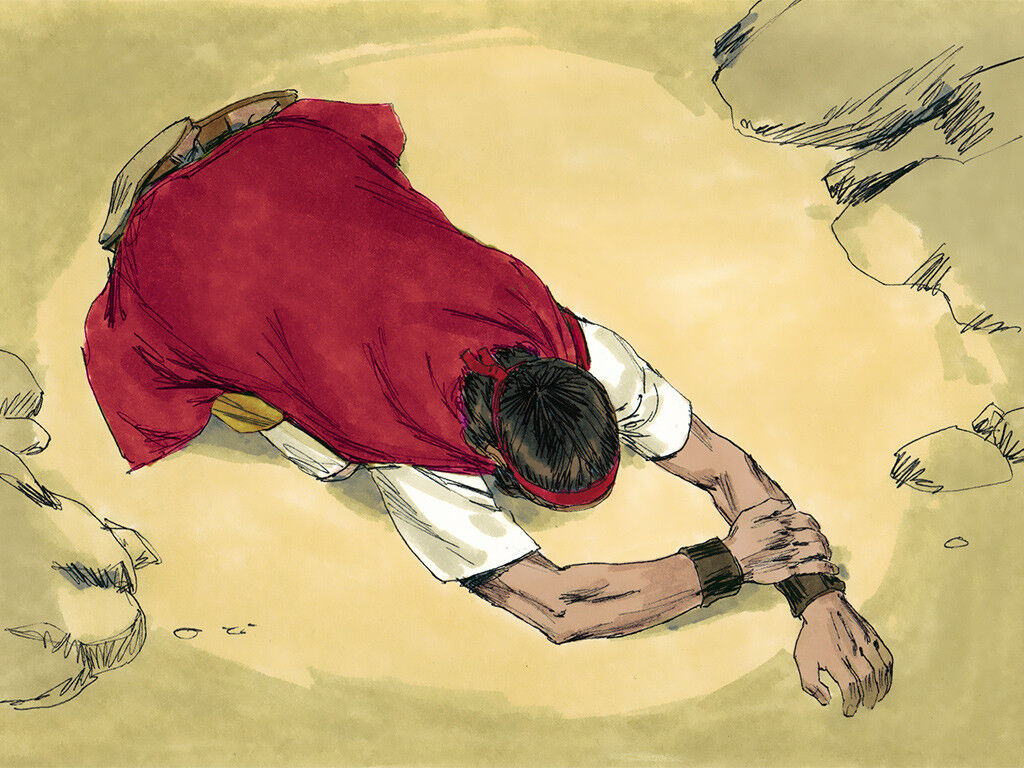
King Rehoboam of Judah: The Kingdom is Divided

1 Kings 12.1-24 | | Lesson 3 | Sunday School Lesson Notes/Talking Points

Read 1 Kings 11.9 – 12.24

I / MAKING THE CONNECTION

  1. The purpose of the books of 1-2 Samuel and 1-2 Kings tell the whole story of the nation of Israel under the reigns of their kings until both the northern and southern kingdoms lost their respective independence by being conquered by their enemies and were carried off into captivity: Saul, David, Solomon, divided kingdom beginning with Rehoboam over Judah and Jeroboam over Israel
  2. Today’s lesson will tell the story about how the united kingdom of Israel was divided into two kingdoms as a result of the split or secession that occurred after the death of Solomon and because of his sin / see ch 11.9-13 & 33
  3. From the time of this story, the divided kingdoms will be called by two names:
    1. Israel: which will be comprised of the ten northern tribes
    1. Judah: which will be comprised of the southern tribe of Judah [and also the tribe of Benjamin / see ch 12.21]

II / LET’S MEET OUR CAST OF MAIN CHARACTERS

[1] Rehoboam: he is the son of Solomon and his successor to the kingship / 1 Kings 11.42-43

[2] Jeroboam: he was a former ‘servant’ of Solomon / ch 11.11 & 26

  1. When Solomon was king, he conducted many major building projects in Jerusalem besides building the Temple for Yahweh. These multiple building projects went on for many years and at great expense to the citizens of the kingdom [excessive taxation] and a heavy burden to the physical workforce required to build them. This will form the context of the protest and the complaint that the citizens of Israel will bring to Rehoboam as we go through this story / see ch 12.3-4
  2. Solomon imposed a widespread draft or conscription among the men of Israel to serve in these building projects / see ch 5.13-18
  3. Solomon appointed Rehoboam to be the chief superintendent of all the workforces of laborers that were required to conduct all these building projects / see ch 11.26-28. You might even say that he ‘served’ as Solomon’s Chief Officer of the Department of Labor [conscripted/forced].
  4. It was while Rehoboam was on one of his missions to oversee one of these projects that the prophet Ahijah met him with the word from the LORD to announce to him that the LORD had determined to ‘tear’ the kingdom away from Solomon’s son and give the reign of the ten northern tribes to him [signified by the tearing of his new garment] / see ch 11.29-39
  5. Word of this meeting between Ahijah and Rehoboam got back to King Solomon, and he attempted to assassinate Rehoboam to eliminate him and prevent this from happening / ch 11.40a
  6. Rehoboam then fled for his life to find refuge in Egypt, and he bided his time there until he heard that Solomon had died … his own survival and Solomon’s death would provide him with the opportunity to fulfill the prophecy that Ahijah had given him earlier from the LORD / ch 11.40b

III / REHOBOAM IS PRESENTED WITH A PETITION FOR REDRESS / vv 1-5

  1. v 1 / Rehoboam prepared himself to be coronated and inaugurated as Israel’s king following the death of his father, Solomon
    1. Shechem was a town about 30 miles N of Jerusalem. It had long been the place where Israel renewed their covenant vows of faithfulness to Yahweh / for example, Joshua 24
    1. Perhaps Rehoboam thought that by going to Shechem, he might co-opt some of that historical significance for himself – that they would renew their faithfulness to him
  2. vv 2-3 / Instead, when he arrived at Shechem, he discovered that the citizens of Israel had been conducting their own townhall meetings among themselves – they were gathered together to present Rehoboam with some serious complaints – an ultimatum – about Solomon’s oppressive demands on them, and they were insisting that Rehoboam reign over them with more respect and consideration
  3. Not only that, but the citizens of Israel had sent word to Jeroboam [who had fled to Egypt to escape Solomon] to come and be their spokesman/advocate to represent them in seeking their redress and relief
  4. v 4 / The gist of their demands was this: “Your father made our yoke heavy. Now therefore lighten the hard service of your father and his heavy yoke on us, and we will serve you.”
    1. They are referring to the conscriptions to do the hard and manual labor of Solomon’s many building projects for all those years … and also for the excessive taxation Solomon had imposed on them to finance them / see II, 1-3
  5. Here’s the irony of this whole situation: Rehoboam may have thought that by going to Shechem, he could co-opt the significance of the site [covenant renewal] to gain their support for him. BUT what he discovered when he got there was that the people were speaking in terms reminiscent of Israel’s oppressive and enslaved labor in Egypt under the Pharaohs. And here was Jeroboam speaking for them having just come back from Egypt … as if Jeroboam would be their new ‘Moses’ to deliver them from their bondage and hard labor!
  6. Rehoboam realizes he’s in a fix … at a crossroads. He’s going to have to make a decision to act on these demands. This crisis is not going to just blow over or go away. He needs some time to consult with his advisors.
  7. So he asks them for a recess – he needs to huddle with counsel: “He said to them, ‘Go away for three days, then come again to me.’ So the people went away.”
  8. NOTE: None of us is sufficiently wise or experienced to make decisions – especially serious and consequential decisions – on our own. We all need wisdom from others.
    1. First, we need to seek God in His Word and through prayer for the wisdom we need. Solomon, his father, had done this in the beginnings of his reign, and Yahweh responded by giving him the wisdom he asked for / ch 3.1-15 & Proverbs 3.1-8
    1. Then we need to seek the counsel from our fellow believers who also are seeking the Lord for their wisdom / Romans 15.14 & Proverbs 11.14; 15.22; 24.1-7
  9. So – what counsel does Rehoboam seek … and listen to?

IV / REHOBOAM CONSULTS WITH HIS ADVISORS / vv 6-11

vv 6-7 / Then Rehoboam took counsel with the old men, who had stood before Solomon his father while he was yet alive, saying, “How do you advise me to answer this people?”

  1. Now we have to realize that these older counselors had been with Solomon from the beginnings of his reign through until the bitter end. They had witnessed Solomon’s wise beginnings when he was seeking Yahweh. They watched and observed – and maybe even tried to warn and counter-advise – as Solomon began to depart from loving Yahweh as he careened on his downgrade, downslide, and ultimate downfall. They were privy to Yahweh’s prophecy to Jeroboam. They were well aware of the issues Rehoboam and the kingdom were facing in this crisis. They had seen it all!
  2. So they advised Rehoboam to listen to the people’s valid protests and grant them the concessions they were demanding. If he would follow their advice, maybe the kingdom could be preserved: And they said to him, “If you will be a servant to this people today and serve them, and speak good words to them when you answer them, then they will be your servants forever.” Sounds good and reasonable, doesn’t it? / see Romans 12.16 & Philippians 2.3-4
  3. In truth: the counsel of the old men sounds like what Jesus commands us to do in Matthew 20.25—28: But Jesus called them to him and said, “You know that the rulers of the Gentiles lord it over them, and their great ones exercise authority over them. 26 It shall not be so among you. But whoever would be great among you must be your servant, 27 and whoever would be first among you must be your slave, 28 even as the Son of Man came not to be served but to serve, and to give His life as a ransom for many.” It’s called ‘servant-leadership’ – leading others not by lording over them for your own advancement, gratification, or the promotion of your own personal agenda … but rather for the benefit and well-being of those you are leading.

vv 8-11 / But, NO! He abandoned the counsel that the old men gave him and took counsel with the young men [‘children’] who had grown up with him and stood before him. Rehoboam had no intentions of following this wise counsel even before he asked for it.

  1. These ‘young men’ or ‘children’ were the peers he had grown up with. You have to know that these younger peers had grown up in the same privileges of power and luxury that they had all enjoyed together. They have their own agenda to preserve. They are not going to jeopardize or forfeit their principal seats at the tables of power to take into consideration any of these demands of these ‘underlings’ whom they expect to serve them like they had served Solomon.
  2. The advice they gave Rehoboam to give the common people is the quintessential expression of haughtiness, conceit, self-centeredness, self-interest, and self-serving arrogance. “Don’t you dare to cave to their demands! We will all lose our shares of power and privilege with you!”
    1. And the young men who had grown up with him said to him, “Thus shall you speak to this people who said to you, ‘Your father made our yoke heavy, but you lighten it for us,’ thus shall you say to them, ‘My little finger is thicker than my father’s thighs. 11 And now, whereas my father laid on you a heavy yoke, I will add to your yoke. My father disciplined you with whips, but I will discipline you with scorpions.’”
    1. By the way, this word ‘scorpions’ appears to be a reference to a barbed whip used at the time for extreme punishment. Again, it is reminiscent of Pharaoh’s extreme and oppressive treatments and beatings he administered to the Israelites in Egypt / see Exodus 5.1-14.
    1. In other words: “I’m not going to concede anything to you! In fact, if you think my father was hard on you, you haven’t seen anything yet! My smallest demand on you will be heavier than my father’s greatest demands. So, prepare to get in line and keep your place as my servants for whatever ambitions I want you to fulfill for myself! LET’S GO!”
  3. vv 12-14 / So that’s exactly what Rehoboam answered back to the people when they re-assembled on the third day to hear his response to their protests
  4. v 15 / NOTE: what you see here is a perfect example of both the sovereignty of God and the agency of man working in coordination with each other. So the king did not listen to the people, for it was a turn of affairs brought about by the LORD that He might fulfill His word, which the LORD spoke by Ahijah the Shilonite to Jeroboam the son of Nebat.
    1. This turn of events is what Yahweh had prophesied to Jeroboam through the prophet Ahijah in ch 11.29-39
    1. But it is also the consequences that Yahweh had repeatedly warned Solomon would be the result of his insistent, protracted, and rebellious sins that Solomon had committed against the covenant that Yahweh had made with David his father / see ch 11.33
    1. So Yahweh did not arbitrarily or capriciously bring this judgment upon Rehoboam without cause. This is Yahweh’s administration of justice in perfect fulfillment of His often-repeated stated word and will.
    1. Solomon broke faith with Yahweh and His covenant and so did Rehoboam. They brought this judgment on themselves – but Yahweh was faithful to His word also by bringing this judgment to pass.   

V / THE NORTHERN TRIBES SECEDE – THE KINGDOM IS DIVIDED / vv 16-20

  1. v 16 / When the people heard Rehoboam’s response, their grievances were confirmed: they knew that Rehoboam had no interest, respect, or consideration of their well-being … only in his own. Rehoboam had violated one of the primary tenets of kingship and leadership that his grandfather David had spoken from Yahweh in 2 Samuel 23.3-4: The God of Israel has spoken; the Rock of Israel has said to me: When one rules justly over men, ruling in the fear of God, he dawns on them like the morning light, like the sun shining forth on a cloudless morning, like rain that makes grass to sprout from the earth.
  2. So they seceded. They broke away from the united kingdom and established a separate kingdom.
  3. vv 17-18 / Rehoboam reigned over the tribe of Judah. When he sent Adoram, his minister over the conscription, to attempt to re-muster the citizens back into service, they stoned him to death. Rehoboam recognized he had lost control over the ten northern tribes, so he fled for his own life back to Jerusalem.
  4. v 19 / So Israel has been in rebellion against the house of David to this day. The kingdom would be divided until both the N and S kingdoms were exiled into their respective captivities.
  5. v 20 / Jeroboam assumed the kingship and reign over the northern kingdom which from that time would be called ‘Israel.’ The southern kingdom of the tribe of Judah would be called ‘Judah.’
  6. vv 21-24 / When Rehoboam gathered an army and thought he would go to war against them to re-unite the kingdom as before, once again Yahweh stopped him through the message of another prophet, Shemaiah, to remind Rehoboam, “…this thing is from Me.”

VI / THE MESSIANIC MESSAGE & GOSPEL PROMISE IN ALL THIS…

  1. “How can this break-up and dividing of the Davidic kingdom and secession of the northern tribes possibly be a pointer to the need and coming of Jesus Christ and His Gospel?” you may ask … “How can this be a pre-enactment of Christ?” In these ways…
  2. It all goes back to the covenant Yahweh made with David in 2 Samuel 7.11b-17 [read it]. Yahweh made two relevant promises in that covenant: [1] He would never take away His steadfast love from David or his Offspring after him – He would establish His kingdom forever, and David’s Offspring would possess His throne forever – but [2] if David’s merely human offspring proved to be unfaithful to Him and broke faith and covenant, He would ‘discipline him with the rod of men.’
  3. None of David’s merely human offspring could possibly fulfill such high standards of faithfulness … only Christ can, and when He comes, He will!
  4. When Yahweh told Jeroboam He would give him the kingship of the northern kingdom, His one caveat was this: And he said to Jeroboam, “Take for yourself ten pieces, for thus says the LORD, the God of Israel, ‘Behold, I am about to tear the kingdom from the hand of Solomon and will give you ten tribes 32 (but he shall have one tribe, for the sake of my servant David and for the sake of Jerusalem, the city that I have chosen out of all the tribes of Israel)…’” / ch 11.31-32 … and again, “Nevertheless, I will not take the whole kingdom out of his hand, but I will make him ruler all the days of his life, for the sake of David my servant whom I chose, who kept my commandments and my statutes. 35 But I will take the kingdom out of his son’s hand and will give it to you, ten tribes. 36 Yet to his son I will give one tribe, that David my servant may always have a lamp before me in Jerusalem, the city where I have chosen to put my Name.” / ch 11.34-36
  5. Yahweh knew and purposed that His covenant was made with Christ who must come, and would come, to faithfully fulfill these promises. He established this covenant and made these promises to Christ – but through David. The everlasting Kingdom and Throne have always been Christ’s! Yahweh was keeping it for Christ and would give it to Him when He comes!
“And behold, you will conceive in your womb and bear a son, and you shall call his name Jesus. 32 He will be great and will be called the Son of the Most High. And the Lord God will give to Him the throne of His father David, 33 and He will reign over the house of Jacob forever, and of His kingdom there will be no end.” Luke 1.31-33

Posted in Sunday School lessons | Tagged , , , , , | Leave a comment

Your Pastor is “a man with a nature like ours” [James 5.17]

“Elijah was a man with a nature like ours”

The last two lessons I have delivered to our Sunday School class have focused on the ministry of Elijah.

In the first lesson, Elijah presided over what had to be at least among the pinnacles of the high points in his ministry. He had called on Yahweh to show Himself to be the true God of Israel by sending fire from Heaven to devour His sacrifice … and He did!

Then, immediately, in the second lesson [which was on the same day, by the way], He suffered what had to be the lowest of the low points of his life – an immediate meltdown in every way he could have melted down. He wilted, caved, panicked, tucked his tail between his legs, bolted, and ran for his life when Jezebel put out a hit on him.

In both of these lessons, I have repeatedly reminded our class that “Elijah was a man with a nature like ours” [James 5.17]. In addition to all the lessons we need to learn about God’s preparations for His coming Kingdom, the Christ, and the Gospel, James also gives us this personal commentary on Elijah’s human nature to reinforce our own personal faith, trust, and confidence in God, especially in matters of our praying.

He does so by opening this window into Elijah’s personal mind, feelings, and emotions [‘psyche,’ if you will]. [This word, homoipathees is used only one other time in the NT, Acts 14.15, where Paul pleads that he and Barnabas are of the same human nature as the Lystrans.] James takes us back to this whole Elijah story to show us that Elijah struggled with real life in real ways … just like we do. And, he didn’t always do so well – and neither do we.

When I have presented this aspect of Elijah’s human nature, I have turned it around to state the converse also: we, too, have a nature like Elijah’s. Which means: we, too, are subject to the fluctuations, vicissitudes, ebbs and flows, ups and downs in our own natures and experiences. And sometimes, they can turn from one polar point to the opposite just with thinking a thought or hearing a word or feeling an emotion.

Then, to take it one step further, given Elijah’s prominence of leadership in both these instances, my mind inevitably turns to our Pastors, and I think of them. We depend upon our Pastors to lead us and pray for us – like Elijah did for Israel.

But, do you pray for your Pastor[s]? And do you remember that your Pastor [or, in our case, Pastors] is “a man with a nature like ours,” too! Here was Elijah, pouring out his heart and life for Israel … even putting his life on the line for them. Wonder if any one of them even thought about praying for him.

Maybe you don’t think like that or that way. But he is. Maybe you’ve assumed too often and too much that your Pastor is ‘a man of steel,’ a man with a bullet-proof nature much different than yours, that he somehow lives above all the struggles that we struggle with day by day, impervious to all the weaknesses that plague us. That somehow, he is gifted with a “spiritual cruise control” that he can set on “mountain top experience speed” and maybe even on “auto steer” and just lean back in his driver’s seat and enjoy the scenery as he keeps going at maximum ministry speed.

Maybe we’ve forgotten or overlooked that your Pastor is just “a man with a nature like ours.” That he, too, has a life, and he has to live it every day just like we do … he lives in a house just like we do … he has a family just like we do … and many daily responsibilities just like we do other than his ministry to us … and he is subject to the same temptations, the same brokennesses, the same disorders, the same dysfunctions, the same messinesses of life, the same ups and downs, maybe even the same loneliness that we are subject to at times. Seasons of discouragement, physical weakness and exhaustion, mental stresses [many of them over us], overloaded and overwhelmed, spiritual dryness or ‘dark nights of the soul.’ We really don’t know what all…

You don’t know what your Pastor is dealing with today. And you don’t have to. But he knows – he’s right in the middle of it all. And his spouse knows also. And she’s struggling with her own.

So, right now – why don’t you think of your Pastor[s] and his wife – and pray for them, each one by name, just like you are expecting that he is praying for you?

And, as you are struggling with your own nature and all the deficiencies of it … just remember that your Pastor is “a man with a nature like ours.”

Posted in I've been thinking, Prayer, Your Pastor | Tagged , , , | Leave a comment

King Asa of Judah: “Because you relied on the LORD…” / 2 Chronicles 16.8

1 Kings 15.9-24 | Sunday School Lesson Notes/talking Points | Lesson 4

Read 1 Kings 15.9-24 & 2 Chronicles 14-16

I / MAKING THE CONNECTION

  1. After the united kingdom of Israel was divided, from now on, the stories of the various kings in 1-2 Kings will alternate back and forth between accounts for the kings of the northern kingdom called ‘Israel’ and the southern kingdom called ‘Judah.’ So you need to look for that reference as you read the various accounts to keep track of which kingdom the king reigned over.
  2. Also, each king’s overall record is evaluated by the phrase “he did right in the eyes of the LORD” or “he did evil in the eyes of the LORD” / “and he walked in the sins that his father had done before him,” or some similar overall assessment.
  3. The king we will learn from in this lesson is King Asa of Judah.
  4. He is the third king to reign over the southern kingdom of Judah:
    1. Rehoboam
    1. Abijam [or Abijah / 2 Chronicles 13.1]
    1. and Asa.

Each of these kings is the son of the king who reigned before him.

  • Asa’s fuller story is told in 2 Chronicles, chapters 14-16, so we will toggle references from the 2 Chronicles account as we try to fill in some of the pertinent acts of his reign.
  • Asa reigned for 41 years / 1 Kings 15.9-10 & 2 Chronicles 16.13
  • Overall…

“Asa did what right in the eyes of the LORD, as David his father had done” / 1 Kings 15.11  “And Asa did what was good and right in the eyes of the LORD his God” / 2 Chronicles 14.2

  • He did have some lapses of his faith in Yahweh his God and some egregious acts of disobedience, especially in his last years – but his overall good assessment is recorded to his credit.
  • What we want to do here is to sketch out some of the prominent chapters of his life and reign as they are recorded in the Scriptures … and learn from them.

“For whatever was written in former days was written for our instruction, that through endurance and through the encouragement of the Scriptures we might have hope” / Romans 15.4

II / ASA WAS A ‘RADICAL REFORMER’ IN JUDAH / vv 9-15

  1. Here are some of the several acts of sweeping reformation Asa instituted in Judah as he sought to rid the kingdom of the idolatrous and obscene rituals of worship that had become commonplace and the ‘norm’ in Judah’s worship
  2. …keeping in mind that these same idolatrous practices had been introduced generations before him, going all the way back even to Solomon [ch 11.3-8, 33] and his grandfather Rehoboam [ch 14.22-24].
    1. He put away the male cult prostitutes out of the land / v 12a
    1. He removed all the idols that his fathers had made / v 12b
    1. He also removed Maacah his mother [grandmother] from being queen mother because she had made an abominable image for Asherah / v 13a
    1. And Asa cut down her image and burned it at the brook Kidron / v 13b
    1. And he brought into the house of the LORD [this was the Temple Solomon had built for the worship of Yahweh, chs 6-8] the sacred gifts of his father and his own sacred gifts, silver, and gold, and vessels / v 15
  3. All of these reforms were his efforts to re-establish the worship of Yahweh in Judah after they had become entrenched in their idolatrous ‘love affairs’ and vile worship practices of all the false gods of the nations around them.

III / ASA RELIED ON YAHWEH FOR AN ASTOUNDING MILITARY VICTORY /

2 Chronicles 14.1-15

  1. Let’s pick up this story from 2 Chronicles 14 that graphically illustrates how God will fight for us and give us awesome victories even over the most formidable of our foes if we will trust and rely on Him.
  2. This battle occurs after about ten years of peace and rest from wars and the assaults of their enemies / see 2 Chronicles 14.1, 5b, 6a, 6b, 7
  3. Yahweh had given Asa this period of peace so he could begin to enact the religious reforms that were in his heart because ‘the heart of Asa was wholly true to the LORD all his days’ [1 Kings 15.14].
  4. There was an attack from the south of Jerusalem by Zerah the Ethiopian. They came up from the north of Africa as far as Mareshah, only about 25 miles SW of Jerusalem.
  5. This was a formidable army, an insurmountable foe, of 1,000,000 soldiers and 300 chariots / v 9
  6. Asa knew he and Judah’s forces were vastly outnumbered and they had no chariots! BUT THEY HAD A GOD – YAHWEH!
    1. Here is a good testimony to God’s promise: “What then shall we say to these things? If God is for us, who can be against us?” / Romans 8.31
  7. So – what does Asa ‘say to these things’? [You need to mark this prayer and promise in your Bible so you can go back to it and pray and trust in when you are faced with your own insurmountable threats against you!]

“And Asa cried out to Yahweh his God, ‘O Yahweh, there is none like you to help, between the mighty and the weak. Help us, O Yahweh our God, for we rely on you, and your Name we have come against this multitude. O Yahweh, you are our God; let not man prevail against you!’” / v 11

  • Yahweh did defeat the Ethiopians. In fact, verse 13 says: “for they were broken before Yahweh and His army!” And Yahweh gave all the spoils of that battle to Asa and Judah. And He will do the same for you and me!

IV / ASA IS FURTHER CHALLENGED AND CHARGED TO TAKE COURAGE FROM THIS VICTORY TO CONTINUE WITH HIS REFORMS / 2 Chronicles 15.1-19

  1. Yahweh placed his Spirit on one of His prophets, Azariah, to meet Asa on his way back to Jerusalem with this charge:

“Hear me, Asa, and all Judah and Benjamin: Yahweh is with you while you are with Him. If you seek Him, He will be found by you, but if you forsake Him, He will forsake you…” / vv 1-2

“But you, take courage! Do not let your hands be weak, for your work shall be rewarded” / v 7

  • So Asa continued on still further with his reforms to restore the worship of Yahweh to Judah.
  • He even went so far as to proclaim a mandatory covenant for all Judah to forsake their idols and commit themselves to worship Yahweh only – under the penalty of death if they didn’t!

“And they entered into a covenant to seek Yahweh, the God of their fathers, with all their heart and with all their soul…” “And all Judah rejoiced over the oath, for they had sworn with all their heart and had sought Him with their whole desire, and He was found by them, and Yahweh gave them rest all around.”  / vv 12-15

  • After this, there was another period of rest and peace from warfare for about 25 years…

Now, let’s turn back to the 1 Kings 15 story … and pick up the next threat against them –

Asa didn’t do so valiantly this time…

V / ASA BUCKLES IN FEAR AND FALTERS IN HIS FAITH IN YAHWEH /

1 Kings 15.16-22 & 2 Chronicles 16.1-6

  1. There was another threat and military attack – this time from the north, from Baasha who was the king of the northern kingdom of Israel:

And there was war between Asa and Baasha king of Israel all their days. Baasha king of Israel went up against Judah and built Ramah, that he might permit no one to go out or come in to Asa king of Judah.

[This was the 36th year of his 41 year reign / 2 Chronicles 16.1]

  • Ramah was only about 5 miles N of Jerusalem on the main travel route between the two kingdoms. What Baasha was attempting to do was to effectively blockade any travel up or down that route. He was building a fortress in Ramah – obviously with the intention of using it to stage future attacks on Jerusalem. This was a bold, brash act of aggression!

…not only against Asa and Judah … but Judah was Yahweh’s Kingdom!

Surely Yahweh will defend His kingdom again!

  • Asa plumb forget about the victory Yahweh had given him and Judah against the Ethiopians 25 years earlier. He had relied upon Yahweh in that battle, and Yahweh had delivered them.
  • But this time, Asa completely bypassed relying on Yahweh and opted instead to rely on Ben-hadad, the king of Syria, to deliver them from Baasha. Asa even plundered the very treasures and gifts that he had previously returned and restored to the Temple … and sent them to Ben-hadad as a bribe-gift to fight Baasha for him. / 1 Kings 15.18-19
  • Ben-hadad did what Asa had ‘bribed’ him to do – he broke his previous alliance with Baasha and went to war against some of Israel’s cities to the north of where Baasha was building in Ramah.
  • The bribe and resulting attack against Baasha worked. Baasha had to abandon building Ramah and go north to defend his cities that were under attack by Ben-hadad. Asa then plundered the very building supplies that Baasha had brought to Ramah, carried them off, and built other cities for himself with them.
  • But – in so doing, Asa had forsaken his trust in and reliance on Yahweh. The prophet Azariah had charged him after Yahweh’s victory over the Ethiopians:

“Hear me, Asa, and all Judah and Benjamin: Yahweh is with you while you are with Him. If you seek Him, He will be found by you, but if you forsake Him, He will forsake you…” / 2 Chronicles 15.2.

Now Asa had gone and done just that!

Now, let’s go back to 2 Chronicles 16 for the follow-up to that breach of faith and reliance on Yahweh…

VI / ASA IS REBUKED BY ANOTHER PROPHET FOR HIS BREACH OF RELIANCE ON YAHWEH / 2 Chronicles 16.7-10

  1. Yahweh sends another prophet, Hanani, to Asa with His rebuke:

At that time Hanani the seer came to Asa king of Judah and said to him, “Because you relied on the king of Syria, and did not rely on the LORD your God, the army of the king of Syria has escaped you. Were not the Ethiopians and the Libyans a huge army with very many chariots and horsemen? Yet because you relied on the LORD, He gave them into your hand. / vv 7-8

  • And then Hanani gives Asa another great and encouraging promise that you would do well to mark in your Bible … and let it encourage you to remember this!

For the eyes of the LORD run to and fro throughout the whole earth, to give strong support to those whose heart is blameless toward Him / v 9

The LORD’s eyes are still running to and fro throughout the whole heart … searching for all of us who are in trouble, searching our hearts also to see if we are committed to being faithful to Him so He can show Himself to be strong to defend and deliver us! When His searching eyes find you … what will He see your eyes looking at or looking to? May He find our eyes of love, faith, and trust locked in on His eyes of Grace and salvation!

  • BUT – because Asa’s heart had grown calloused and cold toward Yahweh … he didn’t take this rebuke to his heart. He resented Yahweh’s rebuke and correction. Yahweh would do what He had said He would do – He would plague Asa with more and further wars because he had relied on human helpers instead of giving Yahweh the opportunity to show His own power and glory by defending them and fighting their [and His] enemies!
  • He took out his anger and resentment against Yahweh on Hanani, Yahweh’s prophet: Then Asa was angry with the seer and put him in the stocks in prison, for he was in a rage with him because of this. And Asa inflicted cruelties upon some of the people at the same time. / v 10

VII / ASA WAS AFFLICTED WITH DISEASES IN HIS FEET /

1 Kings 15.23 & 2 Chronicles 16.11-12

  1. This came upon him “in his old age” and “In the thirty-ninth year of his reign.” Since he reigned 41 years, this was in the last and final 2-3 years of his reign.
  2. Whatever this disease was [gout or some kind of paralysis], it had the effect of crippling him at the end of what had otherwise been a sterling and stellar record of faithfulness and obedience to Yahweh.

We might even apply Paul’s rebuke of the Galatians to King Asa: “You were running well. Who hindered [tripped you up / hobbled you / cut you off] from obeying the truth?” / Galatians 5.7

  • This was the final sad entry on his record. He stumbled and fell at the finish line of his life’s race and service for Yahweh and died at the end of his 41-year reign … an angry, bitter, resentful old man. “Yet even in his disease he did not seek the LORD, but sought help from the physicians.”

Don’t be that guy!

  • Hebrews 12.1-2: Therefore, since we are surrounded by so great a cloud of witnesses, let us also lay aside every weight, and sin which clings so closely, and let us run with endurance the race that is set before us, looking to Jesus, the founder and perfecter of our faith, who for the joy that was set before Him endured the cross, despising the shame, and is seated at the right hand of the throne of God.

TAKEAWAYS… 

  1. Pray that God will keep you faithful to the end! Your spirit may indeed be willing … but your flesh indeed is weak!
  2. Resolve to finish well!
  3. Keep your eyes of love, faith, trust, and reliance fixed on Jesus!
Posted in Sunday School lessons | Tagged , , , , | Leave a comment

“Will the real God please … answer by fire?”

1 Kings 18.1-46 | Lesson 5 | Sunday School Lesson Notes/Talking Points

Read 1 Kings 18.1-46

I don’t know if any of you will remember the old TV show “What’s My Line?” [Be careful here – you’ll ‘out’ that you’re old!] In that show, three ‘mystery’ contestants would appear and be seated side by side. The celebrity panelists would be told that one of these contestants had a particular ‘line’ [as in ‘line’ of work, occupation, vocation, or accomplishment]. The panelists would be given the name of the ‘real’ contestant who was in this ‘line’ of work. They would then question all three contestants [while wearing blindfolds] to see if they could pinpoint, identify, and discern by their answers which one of them actually knew the ‘line’ they had. Each panelist would make a guess which one was the ‘real’ person in that ‘line.’ At the end, the host would say, “Will the real [name] please stand up?’ The mystery contestants would stall, look at each other, and then the ‘real’ person would stand up.

That’s kinda what went on at Mount Carmel. Elijah issued the challenge and set the contest by requesting the ‘real’ God to please send fire to consume the sacrifices they had laid out. That was the evidence by which the ‘real’ God would identify Himself. Of course, only Yahweh could and did answer by sending fire down from Heaven.

I / MAKING THE CONNECTION

  • Our attention will now turn to the northern kingdom of Israel [after the united kingdom of Israel was divided into two kingdoms after the death of Solomon / see Lesson 3]. The first king of the southern kingdom of Judah was Rehoboam, son of Solomon. The first king of the northern kingdom of Israel was Jeroboam.
  • This lesson will focus on the familiar and infamous King Ahab of Israel, husband of Jezebel.
  • We will also meet the well-known prophet Elijah as Yahweh brings him on the scene and into the narrative to deliver His messages to Israel – calling them to repentance and to return back to Him.
  • But, let’s do this first … let’s trace a brief and summary record of those first kings of Israel, and who Ahab is, and where he came from…
  1. Jeroboam: he reigned 22 years /1 Kings 14.20
  2. During the last years of his reign, God sent Ahijah the prophet to announce to Jeroboam that all of his descendants would be ‘cut off’ or slaughtered/massacred / 1 Kings 14.6-16 [wait for it…]
  3. Nadab: son of Jeroboam / he reigned 2 years / 1 Kings 15.25 [the only son of Jeroboam to reign]
  4. His short story is recorded in 1 Kings 14.20 & 15.25-26.
  5. He did what was evil in the sight of the LORD and walked in the way of his father, and in his sin which he made Israel to sin. / 15.26
  6. Baasha: from the tribe of Issachar / he reigned 24 years / 1 Kings 15.33
  7. 1 Kings 15.27 – 16.6: Baasha murdered all the ‘house’/family/descendants of Jeroboam. He gained the throne of Israel by assassinating Nadab, son of Jeroboam, thus fulfilling the prophecy delivered by the prophet Ahijah [see bullet point on Jeroboam above].
  8. He did what was evil in the sight of the LORD and walked in the way of Jeroboam and in his sin which he made Israel to sin. / 15.34
  9. Elah: son of Baasha / he reigned 2 years / 1 Kings 16.8 [the only two kings of this family to reign]
  10. Zimri: one of two of Elah’s military commanders / he reigned all of 7 days / 1 Kings 16.15
  11. As one of Elah’s two chief military commanders, he staged a coup, assassinated Elah, and declared himself king of Israel / 1 Kings 16.9-15
  12. His legacy: “…and died, because of his sins that he committed doing evil in the sight of the LORD, walking in the way of Jeroboam, and for his sin which he committed, making Israel to sin.” / 16.18-19
  13. Omri: the other of Elah’s chief military commanders / he reigned 12 years / 1 Kings 16.23
  14. Not to be out-done by his rival, Zimri, he staged a counter-coup against Zimri and besieged Tirzah where Zimri was living. When Zimri saw he was doomed and to avoid being assassinated, he went into one of his fortresses and committed suicide by burning the house down over him / 1 Kings 16.15-20
  15. However, the northern kingdom was sub-divided again by internal civil war between two rivals, Omri and Tibni / 1 Kings 16.21
  16. Omri overcame Tibni and assumed sole reign over Israel / 1 Kings 16.22-28
  17. It was this Omri who bought the hill that would be named ‘Samaria’ and would be established as the long-lasting capital of Israel / 1 Kings 16.24
  18. Omri did what was evil in the sight of the LORD, and did more evil that all who were before him. For he walked in all the way of Jeroboam the son of Nebat, and in the sins that he made Israel to sin, provoking the LORD, the God of Israel, to anger by their idols. / 16.25-26
  19. Ahab: son of Omri / he reigned 22 years / 1 Kings 16.29
  20. So, then, that brings us now to Ahab. He is introduced to us in 1 Kings 16.28-33. Ahab was not content just to be compared with the sins of those who had come before him … No! he had to out-do them all and set a new low standard for doing evil in the sight of Yahweh – to provoke Him to anger! Which he did! He didn’t just lower the bar – he tried to dig down to the pits of Hell itself and plant the bar there! “And Ahab the son of Omri did evil in the sight of the LORD, more than all who were before him.” / 16.30
  21. Here is some of what he did:
    1. “And as if it had been a light thing for him to walk in the sins of Jeroboam the son of Nebat, he took for his wife Jezebel the daughter of Ethbaal king of the Sidonians, and went and served Baal and worshiped him” / 16.31 – So now we are also introduced to the infamous Jezebel … who not only influenced Ahab, she also ruled over him and told him what to do. At her urging, he also introduced the worship of Baal, the god of the Sidonians into Israel. [That is at the crux of our lesson story here…]
    1. “He erected an altar for Baal in the house of Baal, which he built in Samaria.” / 16.32
    1. “And Ahab made an Asherah. Ahab did more to provoke the LORD, the God of Israel, to anger than all the kings of Israel who were before him.” / 16.33

Now, for the rest of our lesson, we will see how Yahweh responds to all this provocation:

II / “AIN’T GONNA RAIN NO MORE…FOR THREE YEARS” ~YAHWEH / 1 Kings 17.1

  1. Yahweh sends Elijah [his very name means: ‘YAHWEH is God’] to announce to Ahab that He is going to withhold rain and dew for three years … until He says otherwise! [see also James 5.17]
    1. Yahweh makes this pronouncement to emphasize to Ahab that He, Yahweh, is still God and the God of Israel and over Ahab. He is sovereign over them. They are accountable to Him. He is in charge, and He is doing this! Also – He is giving Ahab opportunity to repent.
    1. He sends this word by His faithful prophet Elijah. He speaks through Elijah to authenticate Elijah as His prophet / see ch 18.36
  2. I have always been impressed by Elijah’s statement: “As the LORD, the God of Israel, lives, before whom I stand…” – That is what each of us should do … live and stand in the Presence of God, waiting for Him to give us instructions what He wants us to say and do!
  3. NOTE: this drought Yahweh will send is not His whimsical, petty, or capricious vindictiveness – just because He has the power and authority to do whatever He wants to do. NO! Yahweh had warned them for centuries and generations that He would withhold rain and send drought upon them
    1. …as His judgment on their disobedience, idolatry, and breaking of faith/covenant with Him [see Deuteronomy 11.13-17; 28.20-24]
    1. …and to call them to return to Him with repentance [see 1 Kings 8.35-40; 2 Chronicles 6.26-31; 7.11-14]

III / “GO SHOW YOURSELF TO AHAB, AND I WILL SEND RAIN ON THE EARTH” ~YAHWEH / 1 Kings 18.1-18

  1. vv 1-2 / Yahweh decides it is time for Him to once again show Himself to Israel as their true God. He sends Elijah [‘Yahweh is God’] to make the announcement to Ahab.
  2. vv 3-15 / There is also this sub-story inserted here about Yahweh’s faithful servant, Obadiah, who was also a kind of chief-of-staff for Ahab. “Now Obadiah feared Yahweh greatly…” [ch 18.3] He had already been engaged in secret missions to hide and feed Yahweh’s prophets when Jezebel had engaged in a search-and-kill against them. This would also put him in a tenuous place with Ahab.
  3. v 16 / Elijah sends Obadiah – and Obadiah goes to deliver the announcement to Ahab.

IV / SHOWDOWN AT MOUNT CARMEL / 1 Kings 18.19-40

  • This is the real crescendo of this lesson and this story. There is going to be a showdown on the one of the mountain-tops of the Carmel range [this was a range of mountains in the NW corner of Israel just a few miles from the Mediterranean coast, extending into the valley of Jezreel].
  • This showdown between Yahweh and the prophets of Baal will make the OK Corral one look like playtime at daycare!

Here’s how it went down…

  1. vv 19-20 / THE CALL: Elijah tells Ahab to call [‘send and gather to me at Mount Carmel’] ‘all Israel … and the 450 prophets of Baal and 400 prophets of Asherah, who eat at Jezebel’s table.’ That last phrase means that the worship of Baal and Asherah had become the ‘state-sponsored religion’ of Israel under Jezebel’s leadership … and she was supporting and maintaining them.
  2. v 21 / THE CHALLENGE: The people of Israel were ‘halting’ in indecision or ‘limping’ in their vacillation between Yahweh, whom they knew to be their true God, and the worship of Baal. But they were too weak-kneed and faithless to make the confession they knew they should make and stand up to Jezebel. The CHALLENGE was simple, and straight-forward, clearly-defined: “If Yahweh is God, follow Him; but if Baal, then follow him.”
    1. [This CHALLENGE is so reminiscent of the same challenge Joshua had made centuries earlier when they first entered the Promised Land in Joshua 24.14-28: “Now therefore fear the LORD and serve him in sincerity and in faithfulness. Put away the gods that your fathers served beyond the River and in Egypt, and serve the LORD. 15 And if it is evil in your eyes to serve the LORD, choose this day whom you will serve, whether the gods your fathers served in the region beyond the River, or the gods of the Amorites in whose land you dwell. But as for me and my house, we will serve the LORD.”]
  3. vv 22-24 / THE CONDITIONS [or terms of the contest]: The conditions also were very simple – both Elijah and the prophets of Baal would each be given an altar, wood to burn, and a bull. Each of them would place their bull on their altars with the wood under it – but no fire. “And you call upon the name of your god, and I will call upon the Name of Yahweh, and the God who answers by fire, HE IS GOD!”
    1. Well, that should be proof enough, shouldn’t it? Surely the God who is really God can show Himself and answer by sending down fire to recognize and accept the sacrifice that is made to Him! [Besides, they believed their god Baal controlled thunder, lightning, and storms]
    1. NOTE: God always delights in doing the impossible to show Himself to be God! Like when He did the most impossible of all things … He sent Jesus Christ into the world through the conception and birth by a virgin! “For nothing will be impossible with God!” / Luke 1.37
  4. vv 25-26 / THE CONTEST: Elijah told the prophets of Baal to go first – he would eliminate the competition from the get-go. So, they did. They put no fire under their sacrifice per the conditions of the contest. They began to call on Baal – but, of course, ‘But there was no voice, and no one answered’ … because Baal is not really real – he just was not there! [see Psalms 115.4-8 & 135.15-18]
  5. vv 27-29 / THE CONTEMPT Elijah heaped on them: Elijah mercilessly mocked, taunted, ridiculed the poor prophets of Baal as they futilely continued to rave and beg Baal to respond to them … and as they began to cut themselves in self-sacrifice in the vain hopes of getting Baal’s attention and sympathy – “Cry aloud, for he is a god. Either he is musing, or he is relieving himself, or he is on a journey, or perhaps he is asleep and must be awakened.”
  6. vv 30-38 / THE CONFLAGRATION [OK, for the sake of continuing alliteration, this is just a big word that means a big fire that consumes everything it falls on]: Now it was Elijah’s turn – and more importantly, Yahweh’s turn!
    1. But first, Elijah had to re-build and repair the altar of Yahweh that the Baal prophets had torn down in their frustration and frenzy.
    1. He took twelve stones to represent the twelve tribes of Israel to whom he was appealing – to show them that Yahweh was their covenant God.
    1. Then he dug a trench around the altar deep enough to hold around four gallons of water … because he was going to make this demonstration even more impossible to remove all doubt.
    1. He put the wood on the altar and then laid the pieces of the bull sacrifice on the wood.
    1. And then – he did what? – he gave instructions to go get water and pour it on the sacrifice and the wood … to douse and soak the whole altar! And then, he did it the second time! And then, he did it the third time! until the water was not only soaking the altar, wood, and sacrifice, but it was filling up the trench around the altar! Everything was soaked with water … to make it naturally inflammable! It would take Yahweh, the real God, to ignite this!
    1. Then – Elijah prayed to Yahweh! In the English, it is only about 65 words – but Elijah was praying to Yahweh, the God of the impossible – the God who really lives and is there! “O LORD, God of Abraham, Isaac, and Israel, let it be known this day that you are God in Israel, and that I am your servant, and that I have done all these things at your word. 37 Answer me, O LORD, answer me, that this people may know that you, O LORD, are God, and that you have turned their hearts back.” [Remember: this was the CHALLENGE Elijah had presented to Yahweh and to Israel…]
    1. And then – the conflagration fell from Yahweh! Then the fire of the Lord fell and consumed the burnt offering and the wood and the stones and the dust, and licked up the water that was in the trench.
  7. vv 39 / THE CONFIRMATION: Yahweh confirmed by this physical response…beyond all doubt… that He, indeed, is Israel’s true God – and the only God there is! At least for this moment, the people of Israel who witnessed this confirmation confessed and acknowledged Him: And when all the people saw it, they fell on their faces and said, “The LORD, He is God; the LORD, He is God.” 
  8. vv 40-46 / THE CONSEQUENCES OF THE SHOWDOWN: There were two primary consequences … [1] Elijah ordered that Jezebel’s false prophets of Baal be slaughtered – because they had been instrumental and influential in leading the people of Israel into their idolatry and away from Yahweh; and [2] Elijah then offered his prayer of faith to Yahweh to send rain again. James offers this example of fervent, believing prayer to God for us all to be encouraged to pray ourselves: Therefore, confess your sins to one another and pray for one another, that you may be healed. The prayer of a righteous person has great power as it is working. 17 Elijah was a man with a nature like ours, and he prayed fervently that it might not rain, and for three years and six months it did not rain on the earth. 18 Then he prayed again, and heaven gave rain, and the earth bore its fruit. / James 5.16-18

ONCE AGAIN, WE LEARN THAT YAHWEH HIGHLIGHTS THE FAILURES OF THESE MERELY HUMAN KINGS OF ISRAEL AND JUDAH … AND THE CHRONIC FAITHLESSNESS OF THE PEOPLE … TO TEACH US OUR NEED OF HIS COMING KING, JESUS CHRIST, AND THAT OUR SALVATION WILL BE FOUND ONLY IN HIM!

Posted in Sunday School lessons | Tagged , , , | Leave a comment

Where does a prophet go to resign?

1 Kings 19.1-21 | Sunday School Lesson Notes/Talking points

Elijah: Where does a prophet go to resign?

Read 1 Kings 19.1-21

I / MAKING THE CONNECTION

  1. This story is the sequel and follow-up to our last lesson from chapter 18: ‘Will the real God please … answer by fire?’ Well, Yahweh is the real God – and He did answer by fire from Heaven [1] to show Himself to be God, [2] to evidence His Presence among them, [3] to authenticate and validate Elijah as His prophet – and most of all, [4] to give an irrefutable demonstration and display of His Glory!
  2. Sadly, Elijah’s personal faith and confidence in Yahweh and his courage and boldness that he presented in the showdown on Mount Carmel is also going to crash and burn in the face of wicked Jezebel’s threats on his life. He’s going to turn tail, bolt in fear, and run for his life.
  3. I’m not going to personally find fault with Elijah and criticize him. Yahweh will … but I’m going to let Yahweh do that … and we’re all going to learn from how Yahweh confronted Elijah, re-confirmed his faith, and re-called Elijah back into His service.
  4. So much of this story reminds me of how Jesus confronted Peter on the shores of Galilee after Peter had denied that he even knew Jesus – how Jesus lovingly re-confirmed Peter’s faith in Him and re-called him back into His service / see John 21
  5. Over the course of my 50 years of pastoral ministry, I, too, have often diverted my eyes of commitment to Christ and confidence in Him to my own personal interests and resources. I, too, at times have reverted to thinking that the ministry was about my personal agenda, my ambitions, my expectations, and my resources or even gifts. In those times, I have fallen into seasons [sometimes long, protracted seasons] of self-perceived failure, self-assumed uselessness, fear, anxiety, emotional meltdowns, despondency, and depression. I have tried to resign, and quit from pastoral ministry, and go off to do something else. But God has always come to me at my lowest ebbs, when I had given up on myself, flamed out … and revealed His Glory to me again … and call me to just trust and follow Him on to the next assignment He was pleased to give me to do.
  6. That is Elijah’s story here that we will unpack in this lesson…

II / vv 1-3 / “ELIJAH, JEZEBEL HAS PUT OUT A HIT ON YOU!”

  1. This was after Elijah had ordered the execution of Jezebel’s prophets of Baal / see ch 18.40.
    1. BTW, Yahweh had also ordered the execution of false prophets who would Israel away from loving, serving, and worshiping Him only / see Deuteronomy 13.1-5. The same order would also have included Jezebel and everyone else who willingly followed those false prophets / Deut 13.6-18
    1. Jezebel had also murdered Yahweh’s true prophets who were calling Israel back to Him / see ch 18.4, 13
  2. v 2 / Ahab had gone back to Jezebel and gave her a full report on everything Elijah had done at Carmel.
  3. Jezebel was enraged…she sent a messenger to Elijah to threaten to kill him. And NOTE: she called on the same authority of her gods … that Yahweh had so publicly humiliated that very day! “So may the gods do to me and more also, if I do not make your life as the life of one of them [her prophets] by this time tomorrow!”   
  4. v 3 / Elijah panicked. His boldness, courage, and confidence in Yahweh that he had earlier in the day suddenly caved, evaporated, crashed and burned in an instant. He immediately bolted and ran for his life to Beersheba [on the southern boundary of Judah – about 100 miles south from Jezreel].
  5. I know that all of us can read chapter 19 and scan back through chapters 17-18 and say to Elijah: “But Elijah, can’t you remember
    1. how Yahweh has empowered you, protected you, and provided for you over the last 3 ½ years?
    1. How you prayed and called for this drought and Yahweh sent it?
    1. How Yahweh sent the ravens with food to feed you?
    1. How He sent you to the widow at  Zarephath and worked miracles to provide oil and flour to feed her and her son and you during the drought?
    1. How Yahweh raised the widow’s son from death through your prayers?
    1. How Yahweh showed up at Carmel and sent fire from Heaven to devour His sacrifice – and that one was just earlier today?
    1. How you prayed again and Yahweh raised the small clouds from the Mediterranean as you watched and sent a deluge?
    1. How can you not trust Him now?”
  6. And yet, all of us have been caught in the moments of our lives when we, too, have forgotten where we have been and how the LORD has sustained and provided for us – and all we could see was the perceived danger of that moment of time where we were … like the frame of that moment was frozen and paused and that frame was all the world and history there was. And we were all alone in that frame with the threats against us. God was not in the frame [in our thinking]. And we, too, panicked and ran.
  7. We can joyfully sing: “Through many dangers, toils, and snares I have already come…” and then immediately panic and meltdown when the next one comes…

III / vv 4-8 / WHERE DOES A PROPHET GO TO RESIGN?

  1. v 4 / This is what Elijah is trying to do: resign from being a prophet and quit – and even die! “It is enough; now, O Yahweh, take away my life, for I am no better than my fathers!” In other words: “I have had enough! I can’t take any more! Suicide is not an option – so, O Yahweh, I quit, I resign! Please kill me here on the spot!”
  2. I think we can safely assume that Elijah is thinking thoughts like these:
    1. I thought Baalism would be defeated on the spot today …
    1. I expected Yahweh to send an immediate revival of faith to Israel today …
    1. I thought that there would be an instantaneous rejection of Jezebel and a revolt against her and Ahab today …
    1. I thought that the influence of Jezebel in Israel would be overturned today and maybe she would resign and abdicate in defeat … but none of this happened today!
    1. I have failed – my whole ministry ended in failure today in spite of the awesome demonstration of Yahweh’s supremacy and sovereignty!
  3. That’s the ways our self-assumed expectations can often interpret the Providences of God! Maybe even in this sad resignation prayer Elijah is even blaming Yahweh for not faithfully following through. Maybe he is even thinking that Yahweh had failed him and was abandoning him…
  4. v 5 / What Yahweh knew he needed was a good, long nap. He needed to physically rest after the long, intense emotional expenditure of the day’s ministry.
  5. Yahweh sent an angel to rouse him up. Yahweh had miraculously [again] provided him from freshly-baked bread and a jar of water. He ate and drank – and went back to sleep.
  6. The second time – the angel woke him up, told him to eat and drink again. Yahweh was going to send him still further south about 250 more miles … all the way to Horeb [Sinai] where Yahweh had appeared to Israel and Moses at the giving of the Law.
  7. So Elijah obeyed – ate and drank what Yahweh had provided – and started the journey on down south to Horeb … where Yahweh had planned another appearance to him.

IV / vv 9-18 / “WHAT ARE YOU DOING HERE, ELIJAH?”

  1. v 9 / When Elijah arrived at Horeb, he found a sizable cave [they are plentiful in that region] where he decided to camp a while and process everything that was going on in his soul [Also…he thought he was in a secluded and safe place to hide from Jezebel – however Yahweh knew where he was and was there with him…]
  2. “What are you doing here, Elijah?” This is the question that Yahweh asked Elijah twice: vv 9 & 13. Make no mistake about it: Yahweh knew what Elijah was doing there & why. But He asked Elijah in order to give him the opportunity to tell Yahweh for himself. Yahweh wanted Elijah to have his say and hear himself say it so Yahweh could correct him and put everything into perspective with Yahweh’s purpose – why He was doing everything the ways He was.
  3. v 10 / So, here is Elijah’s response and defense … and again, he repeats this pitiful defense both times Yahweh asked him the question: He said, “I have been very jealous for the LORD, the God of hosts. For the people of Israel have forsaken your covenant, thrown down your altars, and killed your prophets with the sword, and I, even I only, am left, and they seek my life, to take it away.”
  4. Let’s interpret this defense:
    1. “the LORD, the God of hosts” can be translated “God of Armies” which names Yahweh as the Sovereign God over all the ‘hosts’ of earthly kings, kingdoms, and their armies; as well as all the ‘hosts’ of false gods; as well as all the ‘hosts/armies’ of angelic beings – in other words: Yahweh is God over all the inhabitants of earth and Heaven, and He does with them all according to His sovereign purposes and pleasure – and He works His will among them all / see Daniel 4.34-35
    1. I have been very faithful to You in all You have called and sent me to do – I have been jealous and zealous to speak for You, represent You well, and deliver your prophetic messages…
    1. I have been grieved and offended for Your sake when they forsook your covenant, when they tore down Your altars to erect those obscene images for Baal and Asherah…
    1. I have grieved over Jezebel’s massacre of Your prophets – my fellow prophets of Yahweh…
    1. I am the only one left … just me … and now Jezebel has put a hit out on me also…
    1. And, maybe, for all I can see and tell, it appears that even You have abandoned me and are not coming to my defense … I can’t do this alone, especially if You won’t act and take up for Yourself!
  5. v 11 / So Yahweh proceeds to show Elijah that He is, in truth, in charge of His own Kingdom…
    1. Yahweh tells Elijah to go out and stand before Him at the mouth of this large cave: And He said, “Go out and stand on the mount before the LORD.” And behold, the LORD passed by… [much as He did when Moses needed affirmation that Yahweh was with them and prayed, “Please show me Your Glory!” / see Exodus 33.12-23]
    1. a great and strong wind [tornado/hurricane] passed by and tore up the rocks around Elijah – but Yahweh didn’t appear in the wind
    1. an earthquake shook and loosened the massive rocks around him – but Yahweh didn’t appear in the earthquake
    1. a conflagration [fierce, raging, devouring fire] burned up everything around Elijah – but Yahweh didn’t appear in the fire / all of God’s works are not performed in the sensational, spectacular phenomenon that we often want and look for…
    1. THEN, Yahweh whispered to Elijah and asked him the second time: “What are you doing here, Elijah?”
  6. Elijah stubbornly, insistently offered the same pitiful, self-centered defense to Yahweh’s whispered interrogation…
  7. Yahweh then re-commissioned Elijah to go back and proceed with His next steps to fulfilling the purposes He had planned – “I am in charge here, I know what I want to do and will do, and you need to be willing to do what I give you to do … and trust Me to work it out as I have planned – you have not failed, and I have not given up on you – Here’s what I want you to do…”:
    1. Go back by way of Damascus [Syria] and anoint Hazael to be king over Syria / see 2 Kings 8.7-14
    1. Anoint Jehu the son of Nimshi to be the next king over Israel / see 2 Kings 9 & 10
    1. Anoint Elisha to be My prophet in your place
  8. Interestingly, the anointing of Elisha would be the only task that Elijah would personally perform … Elisha would pick up Elijah’s prophetic mantle and continue on with Yahweh’s Kingdom mission / see references above for Elisha’s ministry in the anointing of Hazael and Jehu. But, through the actions of these anointed prophet and kings of Syria and Israel, the worship of Baalism would be destroyed and eradicated from Israel!
  9. v 18 / But Yahweh had one last word to give Elijah: Elijah was NOT the lone surviving follower and worshiper of Yahweh. In spite of Jezebel’s efforts to cancel Him and dethrone Him as the true God of Israel, “Yet I will leave seven thousand in Israel, all the knees that have not bowed to Baal, and every mouth that has not kissed him!”
  10. We may grieve over the apostacies and all the departures from God that we witness around us, not only in our social culture, but also in so many who at least confess to follow God in the religious cultures. But Jesus has promised the ultimate victory of His Kingdom and His churches: “On this Rock I will build My church, and the gates of hell shall not prevail against it!” / Matthew 16.18. Visible evidences may fade and wane, but Jesus will win! Just be sure YOU remain faithful!

V / vv 19-21 / “ELISHA, FOLLOW ME – AND CARRY ON!”

  1. v 19 / To Elijah’s credit, he fixes his eyes of faith back on Yahweh, trusts Him, plucks up his courage, puts his running sandals back on, and heads back to Israel.
  2. Elijah finds Elisha being faithful already in his farming responsibilities. He throws his prophetic mantle over him and calls him into the ministry.
  3. v 20 / Elisha asks for leave to at least wrap up things with his family at home. Elijah grants him permission with this charge: “Don’t forget what I have just done to you!” [‘Go back again – for what have I done to you?’]
  4. v 21 / Elisha faithfully settles all of his affairs at home and with his family … and commits himself to follow Elijah – and Yahweh – to carry on the mission of Yahweh’s Kingdom.

Do not fear what you are about to suffer. Behold, the devil is about to throw some of you into prison, that you may be tested, and for ten days you will have tribulation.  Be faithful unto death, and I will give you the crown of life. / Revelation 2.10

Yet you have still a few names in Sardis, people who have not soiled their garments, and they will walk with me in white, for they are worthy. / Revelation 3.4

Posted in Sunday School lessons | Tagged , , , , | Leave a comment

With Joy I Heard My Friends Exclaim

This coming Lord’s Day will mark the 5th anniversary of our uniting with our church body, Buck Run Baptist Church, to worship and serve God in company with them.

I know I have told this story at other times and in other places, but it is never lost on us every time we gather with our fellow members for worship, fellowship, and service… When I resigned my former pastorate on 28 May 2017, we hadn’t made any advance plans or preparations for where we would serve after that. We just knew we were going to continue following Jesus to worship and serve Him where He chose to lead and place us.

In God’s Divine Providence, and through conversations with mutual ministry colleagues God had already woven into my life in preparation for this juncture, I met and talked with our Pastor Hershael York that next week. We first visited Buck Run Baptist Church on 11 June of that year. We knew we were home from that first visit. We continued to attend, counsel, and pray over the next six weeks.

Then on 23 July 2017, we presented ourselves to our church body to announce our commitment to worship and serve the Lord in company with them – as we have done with joy for the past five years.

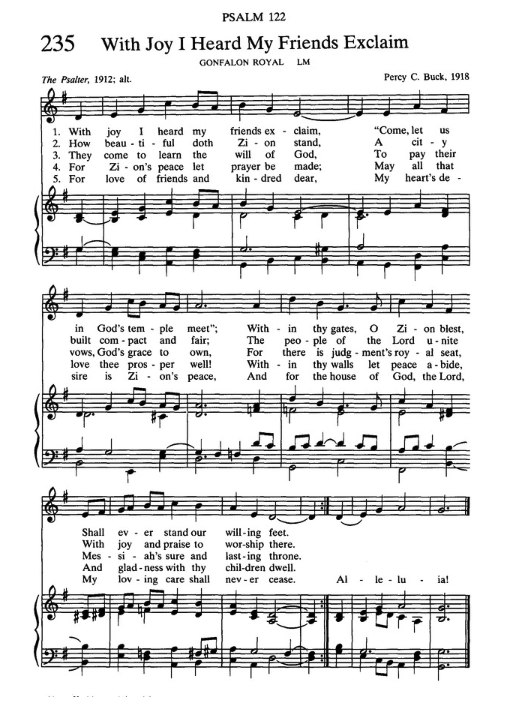
I have just recently come across this hymn. It is a poetic paraphrase of Psalm 122. The author is W. Boyce, but I have been unable to find any sort of biographical information on him other than it was published in the (Presbyterian) Psalter, 1912.

Since this hymn distills, encapsulates, and expresses, not only the spirit and joy of Psalm 122, but also our own spirit and joy when we first made our commitment – which has continued to this present time – I want to share it with you to celebrate this anniversary.

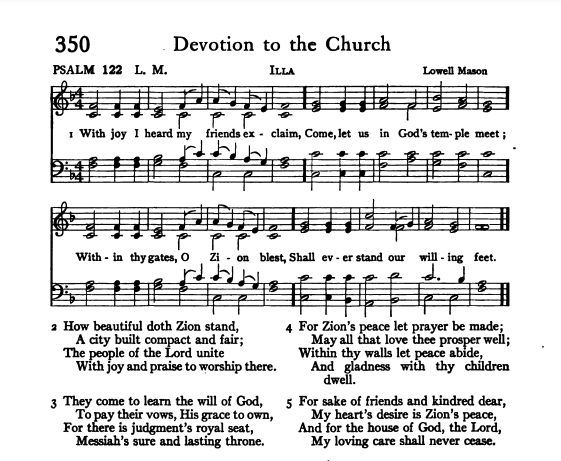
I am offering it here as a testimony of our thanksgivings to God and also to our fellow worshipers and servants of God at Buck Run: “With joy I heard my friends exclaim, ‘Come, let us in God’s temple meet!’”

1 With joy I heard my friends exclaim,
“Come, let us in God’s temple meet”;
Within thy gates, O Zion blest,
Shall ever stand our willing feet!

2 How beautiful doth Zion stand,
A city built compact and fair;
The people of the Lord unite
With joy and praise to worship there.

3 They come to learn the will of God,
To pay their vows, God’s grace to own,
For there is judgment’s royal seat,
Messiah’s sure and lasting throne.

4 For Zion’s peace let prayer be made;
May all that love thee prosper well!
Within thy walls let peace abide,
And gladness with thy children dwell.

5 For sake of friends and kindred dear,
My heart’s desire is Zion’s peace,
And for the house of God, the Lord,
My loving care shall never cease.

Alleluia!

W. Boyce, 1912 Psalter

From The Psalter, 1912
From another hymnal – different tune
Posted in HYMNS | Tagged , , , , , , , | 1 Comment

“Mom, I love you!”

“Mom, I love you!”

Our Mom turns 93 tomorrow, 6/26.

Mom has been the sweetest model and influence of love and grace in my life and the life of my other five brothers and sisters.

I have told people for years “Don’t even try to out-sentimentalize me over my Mom!” But it isn’t just sentimentalism; it’s genuine, passionate, heart-felt, and heart-held love for her. And it’s gratitude to God for ordaining that she would give me birth and be my Mother.

I often tell her, “Mom, you didn’t just give me life – but you have given me your life. You have lived your whole, entire life for me and for all of us, your children!” Our Mom has sacrificed and given the last 74 years of her life for us since the birth of my older brother inducted her into Motherhood. Mom was always there – and still is – teaching us, training us, instructing us to love God and others, showing by her own example how to be gracious and forgiving, insisting that we use our manners and be respectful, requiring that we be responsible to our word and commitments, stand by and stick with each other through thick and thin, and most of all, praying for us by name to this day that God would make it work in us.

So, Mom, “I love you!” never seems to be enough, but sometimes it’s the best and most I can say. “Mom, I love you!”   

Mom, 2 years old, with her Mom, Grandma Hemric
Mom, on the left, with her Mom and three brothers – early 1940s
Mom, 17 years old
Mom, with my sisters and sister-in-law – well, they just called it “Wild Gals” – how the west was tamed
Mom, on my Dad’s Harley – 19 years old
Mom, on my brother’s Harley
Mom – I just call this ‘pretty in pink’ [or any other color]
Mom and me – 2015
Mom and me – 2018
Mom and me – 2019
Mom and us – 2022
Posted in I've been thinking, Mom | Tagged , | 1 Comment

“I love you for love’s sake…”

Where it all began…

“I love you for love’s sake…”

I’ve been wanting to tell this part of our love story for years, but am just now getting to it. This is where the marriage chapter of our love story began with my proposal to Debbie – when I asked her to marry me.

What you are looking at here is a picture of the spot where I proposed to her August 11, 1975. We would marry on June 18, 1976.

This is in the Lexington [Kentucky] Cemetery. Yes, I proposed to Debbie in the Lexington Cemetery. Those of you who are familiar with the Lexington Cemetery know that it is not just a cemetery – it is also a park and arboretum of natural beauty and is listed on several historic registers.

Debbie and I had spent many an hour strolling through the cemetery during the months before this. I was pastoring 400 miles away, and so when I had an opportunity to come and visit with her, we would make our way to Lexington cemetery where we could just be quietly together as we admired the beautiful, cultivated landscaping that is one of its distinctive characteristics. During the summertime, as we strolled and conversed together, we would often remark that the rustling of the wind through the leafed branches of the trees was actually the trees ‘clapping their hands’ [Isaiah 55.12] as they celebrated with us and shared the joy of our newly-awakened and declared love.

The picture is of a small clearing on the bank of one of the small ponds in the cemetery. We had been there before just to sit and talk with one another. It was on this spot right in the center of the picture that we sealed our love commitment to one another.

Back in the day, there was a crabapple tree there. It has since been removed, but it would have stood just to the left of where that first tree is now.

Why a crabapple tree? Well, I was determined that our love story would be as close to a Song of Solomon kind of love story as I could make it. I was reading and meditating a lot in the Song of Solomon. I read in SoS 8.5 [KJV], “I raised thee up under the apple tree…” I also was reading that some commentators speculated that maybe Solomon was reminding his ‘Love’ [SoS 1.15; et. al.] that it was under this ‘apple tree’ that he had declared his love for her and made his own proposal for marriage. Yes, I know … I also was reading that their ‘apple’ tree was not an apple-apple like we first think of, but rather most probably some kind of citron or citrus tree. But we had none of those within hundreds of miles. And a crabapple tree was the closest ‘apple’ tree I could find, and it was in our favorite spot anyway.

So, a crabapple tree would do! And it did just fine! [BTW, when we built where we live now, we planted a crabapple ‘love tree’ right outside our front door–and like our love, it’s still there! And every time we open our front door, our vision is filled with the centerpiece of our ‘love tree.’]

So on that day, we went on one of our romantic visits to this familiar spot in the Lexington Cemetery. We parked the car out on the road and walked over the bank of the ‘duck pond’ [as we called them – because there were always ducks on the ponds]. I had my autoharp with me, which was not all that unusual because I would frequently serenade her with songs, some of which I had written to sing to her.

I had written a special proposal song just for this occasion. I titled it “I love you for love’s sake.” That line was very familiar to both of us – and still is.

So that brings up another one of our common interests. We had met for the first time a couple years before when her Dad had invited me to come up from NC to preach in a Youth Conference they hosted in their church. Although it would another year or so before we even began seriously corresponding with one another, from our very first meeting and encounter, we discovered that we both shared a love for poetry, particularly older English poetry/literature. Even when we just ‘buddies forever,’ we would sit up late into the night and read English poetry together and to each other. We kind of had our own little private two-member “Dead Poets Society.”

Later, as our affections began to deepen, our common interests gravitated to the love poetry between Robert Browning and Elizabeth Barrett Browning, especially her “Sonnets From the Portuguese.” Her Sonnet 14, “If thou must love me…” was one of Debbie’s favorites:

If thou must love me, let it be for nought
Except for love’s sake only. Do not say,
“I love her for her smile—her look—her way
Of speaking gently,—for a trick of thought
That falls in well with mine, and certes brought
A sense of pleasant ease on such a day”—
For these things in themselves, Belovèd, may
Be changed, or change for thee—and love, so wrought,
May be unwrought so. Neither love me for
Thine own dear pity’s wiping my cheeks dry:
A creature might forget to weep, who bore
Thy comfort long, and lose thy love thereby!
But love me for love’s sake, that evermore
Thou mayst love on, through love’s eternity.

She had sent me this sonnet, insisting that if I was to love her, it must be ‘for love’s sake only’ – and not for any other physical trait, appearance, or characteristic that could change and thus un-work the love that had been professed for its sake. “If thou must love me, let it be for nought except for love’s sake only … But love me for love’s sake, that evermore thou mayst love on, through love’s eternity.”  

I was already committed to loving her ‘for love’s sake only.’ And, in fact, I had often sung for her the other old Irish Thomas Moore song:

Believe me, if all those endearing young charms,
Which I gaze on so fondly today,
Were to change by tomorrow and fleet in my arms,
Like fairy gifts fading away,
Thou wouldst still be adored, as this moment thou art,
Let thy loveliness fade as it will;
And around the dear ruin each wish of my heart
Would entwine itself verdantly still.

It is not while beauty and youth are thine own,
And thy cheeks unprofaned by a tear,
That the fervor and faith of a soul can be known,
To which time will but make thee more dear.
No, the heart that has truly loved never forgets,
But as truly loves on to the close
As the sunflower turns on her God when he sets
The same look which she turned when he rose.

So I was already all in for loving her ‘for love’s sake only,’ for the beautiful, noble, gracious, godly woman I knew her to be and whom I had come to love so deeply and truly.

But, I have digressed here, I know.

Getting back to the proposal song I had written to sing to her under the crab‘apple’ tree, “I love you for love’s sake”

I wrote these proposal lyrics and sang them to the tune of another love song that was popular at that time, “Eres Tu”:

I love you for love’s sake, Yes, I do! Yes, I do!

I’ll love you forever and a day!

I strive for expression, but all I can say is:

Debbie, Oh, Debbie, I love you!

            I love you! I want to be with you forever-

            I love you! My fairest Dove, my Chosen One,

            I love you!

I no longer doubt it, No, I don’t! No, I don’t!

I’m sure now forever and a day!

I just can’t be happy if you are away,

Because Debbie, Oh, Debbie, I love you!

            [repeat chorus]

I’ll keep you here with me in my dreams – in my dreams!

I’ll keep you forever and a day!

There’s no place so distant as to keep you away,

Because Debbie, Oh, Debbie, I love you!

            [repeat chorus]

I want to take refuge in your heart, in your heart!

And rest there forever and a day!

So, Debbie, I pray thee, do not turn me away –

Because Debbie, Oh, Debbie, I love you!

            I love you! I’ll give you all my love forever –

            I love you! I wait to hear, my Debbie dear,

            “Do you love me, too?”

And so, that day, there in the Lexington Cemetery, I “raised her up under that crab‘apple’ tree” with the words of that love song, and she graciously consented to receive the promise of my ‘love for love’s sake’ and share hers with me.

The crabapple tree may be long gone, but our ‘love for love’s sake’ is going on.

Posted in Debbie, For Debbie, Love songs | Tagged , , , , , | 4 Comments

Five Simple, Essential Questions to Ask of Every Text

I have developed these Five Simple, Essential Questions to Ask of Every Text by teaching and training myself over years of daily Bible reading, study, and meditation. These are the questions I have asked of the text as I sought to better understand the mind and will of God through His Word and apply its truths to my life. I just instinctively ask these questions and am searching for the answers to them as I read the Scriptures.

Yes, at first, I read the Bible mainly just to know and familiarize myself with the content of Scripture: historical, theological, doctrinal, etc.

But the more I read, the more I came to recognize and experience the immediate Personal interaction God has with us through His words [Hebrews 4.12-13; 1 Peter 1.23-2.3; et. al.]. Also, 1 Corinthians, chapter 2, was a pivotal and transformative Scripture to that end.

I have adopted these five goals that I’m always asking God for:

  1. Reading
  2. Understanding/Interpretation
  3. Application
  4. Implementation
  5. Obedience

I have shared these Five Questions at least verbally with every ministry of the Word I have ever been privileged to have. But only recently have I written them out. This is only a brief sketch of all the exercises that go on in my mind and heart as I read the Scriptures.

I share them with you with the prayer to God that it will help you to “Do you understand what you are reading?” [Acts 8.30].

FIVE SIMPLE, ESSENTIAL QUESTIONS WE SHOULD ASK OF EVERY TEXT

#1 / What do the words say?

  • Exercise: Reading [w/Praying & Meditating]

         Read 1 Corinthians 2

  • Look for:
    • Lead words & follow words
    • Primary words & subordinate words
    • Main words & support words

#2 / What do the words mean?   

  • Exercise: Understanding / Interpretation
    • Hermeneutics & Exegesis
    • Contextual ‘re-creation,’ Linguistics, & Logic
    • NOTE: we are not asking “What do the words mean ‘to me’?” but rather “What do the words mean ‘to God’?” because God says what HE means, and HE means what HE says – and that’s the meaning we must seek [see 2 Peter 1.19-21]
    • Pray & ask God for His Divine Authorial Intent

         Read Acts 8.26-35 [always look for the ‘Christ Key’]

#3 / What will it look like when I do the words of this text?

  • Exercise: Application

         Read 1 Thessalonians 2.13 & Acts 1.1

#4 / Am I doing what this text teaches?

  • Exercise: Implementation

         Read James 1.22-25

#5 / If I am not, when am I going to start?

  • Exercise: Obedience
  • NOTE: NOT “If I am not, WHY not?” because there is NO excuse, reason, or justification for disobedience; but rather “WHEN am I going to repent and start obeying?”

         Read 2 Timothy 3.14-17

HERE IS AN EXPANDED VERSION OF THE ABOVE OUTLINE SUMMARY. I was asked to deliver it in a service and prepared these Lesson Notes…

Here it is in a 2-sided, printable pdf format suitable for handout. You are free to use it in any way that will be helpful.

Posted in Bible Reading, Bible Studies, I've been thinking | Tagged , , , , | Leave a comment

Tribute to my Friend, Shirley Fields

Shirley Fields

Shirley was [and still is and will be forever] my dear sister in Christ, treasured friend, and faithful fellow servant of the Lord and our church for decades. Her matriarchal and motherly influence extended far beyond her own large family and blessed us all. It is my honor to give a tribute to her and her Savior on behalf of so many who love her. Pray for her precious family.

My Memorial Tribute to my Friend, Shirley Fields…

Facebook Live Stream of the Memorial Service: https://www.facebook.com/kerrbrothers.livestreams.5/videos/3189146691406929

Shirley’s obituary:

Posted in Funeral/Memorial Tribute, Memorial Tribute, Tributes | Tagged , , | 2 Comments