Joshua / Judges / Ruth | Lesson 4 | Lesson Notes / Talking Points
Judges 3.7—5.31
The Downward Spiral of Israel’s Apostacy, part 1
I | INTRODUCTION / CONNECTIONS / CONTEXT
1 / This is now the second of four survey studies we will be conducting here in the Book of Judges. All we can hope to do is survey the ‘landscape’ of the book.
2 / The over-arching theme of the book is Israel’s apostacy. Apostacy means ‘to move away from [apo] where you once stood [stacy] to stand or station yourself in another place. In Israel’s case, it meant moving away from standing in faithful obedience to Yahweh and the covenant commandments He had given them. They moved away from faithfulness to His covenant obedience to ‘stand’ or ‘station’ themselves as worshipers of the false gods of the nations around them in the Promised Land, Canaan.
3 / This apostacy is summarized for us in the opening paragraphs of Judges, especially in ch 2.11-15. These same scenes summarized here will play in loops all throughout the book in the twelve ‘short stories’ or biographies of the judges whose stories are told in the book.
II | STRUCTURE: DIVISIONS / SECTIONS OF JUDGES
We will divide the book into four sections in this summary survey. The book clearly divides itself into three sections—with the second section sub-dividing itself into two sections also. Here are the sections:
[I] chs 1—3.6: The Roots of Israel’s Apostacy. Here, the narrator will give us the background information that will lead them into their apostacy from covenant obedience to Yahweh. The roots of their apostacy are explained in two scenarios. [1] ch 2.21, 27-36 describes how tribe after tribe did not drive out the Canaanites as Yahweh had commanded to do in Deuteronomy 7. ‘Incomplete’ obedience is disobedience. When they did not drive out the Canaanites, but chose rather to coexist among them, the Israelites conformed to their ways. As a result, they repeatedly were subjugated by the enemies they had been commanded to drive out. [2] As we have already noted above in ch 2.11-15, instead of loving The LORD their God with all their hearts—as they were commanded to do in Deuteronomy 6—they did what was evil in the sight of The LORD and served the Baals and the Ashtaroth [abominable false gods of the Canaanites] … abandoned The LORD, the God of their fathers, who had brought them out of the land of Egypt. They went after other gods, from among the gods of the peoples who were around them, and bowed down to them … They abandoned The LORD and served the Baals and the Ashtaroth… As we shall see, this cycle was repeated during the 300-350 years or so of the Judges.
[II] chs 3.7—16.31: The Downward Spiral of Israel’s Apostacy. This is the real ‘meat’ of the book. These chapters will give us the twelve ‘short stories’ or biographies of the various judges whom The LORD raised up to save them from their local oppressors. But the reason there are so many cycles of apostacy is stated in ch 2.19: But whenever the judge died, they turned back and were more corrupt than their fathers, going after other gods, serving them and bowing down them. They did not drop any of their practices or their stubborn ways. Over and over again this cycle repeats itself over this Judges span of time. [We will divide this section into two lessons: chs 3.7—5.31 and chs 6.1—16.31.]
[III] chs 17-21: The Depths of Israel’s Apostacy. These chapters are not a continuation of the biographies of the judges, but they did occur at some point during these times. But what we will find in those stories when we get to them are two representative narratives of just how far Israel had apostatized from Yahweh’s covenant faith. These two stories will relate some of the darkest, most debauched and sordid accounts in Israel’s history. Yes, there are still some graphically dark events yet to come during the days of some of the kings, but these are representative of just how deep into apostacy Israel descended during these early days of their times in the Promised Land.
III | CYCLES [& RE-CYCLES] OF ISRAEL’S APOSTACY
1 / As we get into these ‘short stories’ or biographies of the twelve individual judges, we will see this cycle of apostacy repeat itself each time. I have given you in our last lesson a series of five stages in each cycle:
[1] Sin (apostacy);
[2] Subjugation (being subjugated to their neighboring oppressors);
[3] Supplication (crying out to The LORD for deliverance);
[4] Salvation (The LORD raised up the judge to deliver them);
[5] Sin ‘again’ (returning to their apostatizing ways—even more so) … and cycle re-cycles.
2 / Or, we can break it down even more into these components:
[1] Israel does evil in the sight of The LORD;
[2] The LORD ‘sells’ or gives His people over into the hand of their enemy oppressors;
[3] Israel cries out to The LORD to save them;
[4] The LORD raises up the judge, or deliverer;
[5] the judge delivers Israel from the hand of their oppressors;
[6] the land has rest and peace for a period of time;
[7] the judge dies, and the people revert once again to their covenant-breaking, Yahweh-forsaking ways.
3 / NOTE: Everyone of these seven elements may not be found in all of these judges biographies—but the Judges narrator includes them in enough of the individual accounts to let us know that they are present and active even if each one is not specifically detailed.
IV | TWELVE ‘SCENES’ OF APOSTACY & JUDGES IN TWO ACTS
Let me give you just one more clue to help you follow the writing plan or structure of the Book of Judges. This will help you see what the author/narrator wants to show us about this downward spiral of Israel’s apostacy. As you read through this section of Judges that gives us the narratives of these twelve judges, we will discover that this lengthy section is actually divided up into two sub-sections. Each of these two sub-sections will give us the biographies of three ‘major’ judges with six other ‘minor’ judges inserted into the narrative.
[1] In chs 3.6—5.31 there are three major judges: Othniel, Ehud, and Deborah/Barak. There is also a ‘minor’ judge, Shamgar, who is given one verse in ch 3.31, with another honorable mention in ch 5.6.
[2] In chs 6.1—16.31 there are three more major judges: Gideon, Jephthah, and Samson. There are also five ‘minor’ judges who are noted during this narrative: [Abimelech, ch 9, is technically not a judge like the others, but a self-declared king wannabe–interloper], Tola and Jair, Ibzan, Elon, and Abdon.
V | ch 3.7-11 Othniel
1 / Othniel is the first judge to be named. In his account, we will find every one of the seven components of the judges apostacy cycles noted above in III (2/). What the narrator wants to do here is to set the pattern we will find in each of the following judges’ biographies. We would do well to fix this pattern in our minds as a template into which we can fit all the following accounts.
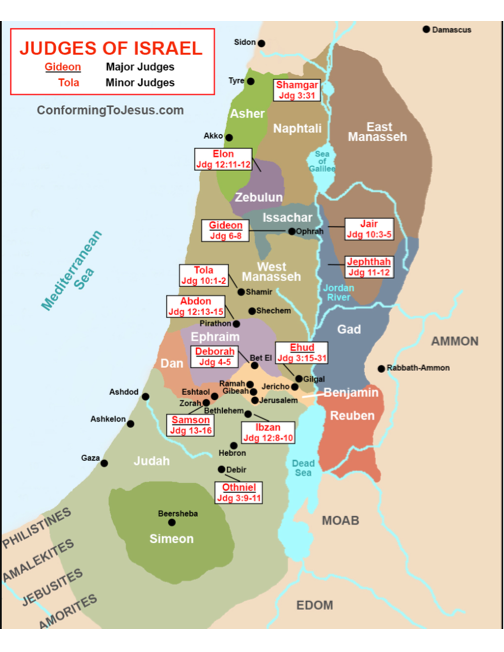
2 / In Othniel’s time, the neighboring oppressor was Cushan-rishathaim [‘Cushan the double-wicked’] king of Mesopotamia. Locate Othniel on the map I have provided for you on page 4 down in the south-central regions of Israel in Judah. Mesopotamia was a then-current superpower to the NE of Israel. Sometimes it is called ‘Aram,’ and is the regions around the Euphrates River. This is the same region where Abram was when The LORD called him to come south to the land He would show him and give him. And, it is also the same region where Jacob fled to live with Laban when he was fleeing Esau.
3 / We have met Othniel before in ch 1.11-15 and Joshua 15.13-19. Othniel was the son of Kenaz, Caleb’s younger brother—Caleb’s nephew. And being from the tribe of Judah [the prophetic kingly tribe, Genesis 49.10], it is fitting that the first ‘deliverer’ whom The LORD raised up would be from Judah—the tribe, of course, from whom Christ will come. This family of Caleb, Kenaz, and Othniel seem to be a God-fearing family who like Caleb ‘wholly follow and trust Yahweh.’ In other words, they were a covenant-keeping family.
4 / Note also that Israel’s faithless covenant-breaking sin is described as ‘They forgot The LORD their God and served the Baals and the Asheroth.’ This forgot is not a lapse of memory—rather it is a blatant and intentional disregarding and turning away from—apostacy.
5 / In all of these accounts, like we noted in our survey of Joshua, the prominent actor is not the human judge or deliverer. The judge is only the human agent in each space and time. The prominent Actor is Yahweh Himself! “Therefore the anger of The LORD was kindled against Israel, and He sold them… But when the people of Israel cried out to The LORD, The LORD raised up a deliverer for the people of Israel who saved them… The Spirit of The LORD was upon him… and The LORD gave Cushan-rishathaim…into his hand.”
6 / “The Spirit of The LORD” will also come upon three other judges: Gideon, ch 6.34; Jephthah, ch 11.29; Samson, chs 13.25; 14.6, 9; 15.14.
VI | ch 3.12-30 Ehud
1 / The second of the three major judges in this first series is Ehud. NOTE the 7th element in the apostacy cycle we have listed above [OR #5 in the previous steps of apostacy: “Sin ‘again’”]: ‘the judge dies, and the people revert once again to their covenant-breaking, Yahweh-forsaking ways.’ Ch 3.12 says, “And the people of Israel again did what was evil in the sight of The LORD…” And so the second cycle of apostacy begins…
2 / In Ehud’s time, the oppressor was Eglon the king of Moab, a neighboring nation to the SE of Israel on the eastern coast of the Dead Sea. The Moabites were the descendants of the incestuous relations Lot had with his two daughters, Genesis 19.36-37. [Moab is also the country from which Ruth will come.] Locate Ehud’s notation on the accompanying map on page 4 in central Israel just W of the Jordan River.
3 / “The account of Ehud is filled with humor, irony, wordplay, and graphic scenes of deliverance. If these events were to be depicted on television or film, they would certainly come with a strong parental warning.” Miles V. Van Pelt, ESV Expository Commentary. Long story short, Eglon king of Moab was a very fat man, and Ehud delivered Israel from his hand by paying Eglon an official visit and assassinating him by stabbing him in his belly, rupturing his intestines, and leaving his dagger in his belly.
VII | ch 3.31 Shamgar
Shamgar is given one verse of text, though he is mentioned one more time in ch 5.6. You can locate Shamgar on the judges map in the extreme N region of Israel—though his activity was probably more down in the S region on the Mediterranean coast where the Philistines inhabited: Ashdod, Ashkelon, Gaza. He serves as a bridge between Ehud [‘after him’] and the accounts of Deborah and Barak
VIII | chs 4-5 Deborah and Barak
1 / Deborah’s service is located in the central part of Israel. The oppressor during her time was Jabin king of Canaan. Deborah was a wise woman who gained a wide reputation for giving counsel and judgment. Deborah’s role is a credit to her for sure; but her service also more importantly shows the absence and neglect of the men of her time from ‘manning up’ and serving as they should. This is emphasized and accentuated by her charge to Barak to assume the role of deliverer [ch 4.4-7]…and Barak’s cowardly response that “If you will go with me, I will go, but if you will not go with me, I will not go” [ch 4.8].
2 / The LORD did deliver Israel by the hand of Barak [and Deborah’s charge to him], but the means by which Yahweh chose to deliver Israel was facilitated by another noble and brave woman, Jael, the wife of Heber the Kenite [ch 4.9, 17-23]. Jael hammered a tent peg through the temple of Sisera, Jabin’s general and delivered him dead to Barak.
3 / The song of Deborah and Barak in ch 5 is a hymn of praise to Yahweh for His spectacular intervention in saving Israel.