Joshua/Judges/Ruth | Lesson 5 | Lesson Notes / Talking Points
Judges, chapters 6-16
The Downward Spiral of Israel’s Apostacy, part 2
I | INTRODUCTION / CONNECTIONS / CONTEXT
1 / As we have already learned, the Book of Judges is divided up into three distinct larger sections—though each of these sections will have other sub-divisions within them:
[I] chs 1—3.6: The Roots of Israel’s Apostacy [Lesson 3]
[II] chs 3.7—16.31: The Downward Spiral of Israel’s Apostacy [part 1, Lesson 4]
[III] chs 17-21: The Depths of Israel’s Apostacy [next lesson]
2 / Of course, just from looking, you will note that the over-arching theme of Judges is ‘apostacy,’ that is, ‘standing away from’ where you formerly stood or had stationed yourself. In Israel’s case, their ‘standing’ was in the covenant Yahweh had made with them and given them, going all the way back to Abraham. But now, after Yahweh had faithfully fulfilled every covenant promise He had made to them by delivering them from bondage and slavery in Egypt, faithfully leading and providing for them in their wilderness wanderings, and now bringing them into the Promised Land as their inheritance and rest … but now, they are forgetting, forsaking, and abandoning their commanded obedience to Yahweh. And they did this in the most blatant and egregious ways! See again the historical summary in the introduction, ch 2.6-23.
3 / So, the Book of Judges describes Israel’s ever-repeating cycles of apostacy. We have itemized them before, but I will name them here again so we can see them played out in the stories of the judges who are named in this present lesson section: [1] Sin (apostacy); [2] Subjugation / Servitude (being subjugated to serve their neighboring oppressors); [3] Supplication (crying out to The LORD for deliverance); [4] Salvation (The LORD raised up the judge to deliver them); [5] Sin ‘again’ (returning to their apostatizing ways—even more so) … and cycle re-cycles. See also the ‘seven steps’ of apostacy, Lesson 4 / III.
4 / We will now do a quick and brief survey of the second section of this larger ‘centerpiece section’ of the Book of Judges: “The Downward Spiral of Israel’s Apostacy.” This larger section [chs. 3.7—16.31] contains the ‘short stories’ or biographies of the twelve named judges plus one renegade, rogue ‘king wannabe’ by the name of Abimelech [ch 9]. He is a kind of outlier here among the other judges, but yet he also serves as an illustrious example of the apostatized faithless and rebellious spirit that pervaded this whole period of Israel’s history: “In those days there was no king in Israel. Everyone did what was right in his own eyes” [ch 21.25]. In truth, they did have a King, Yahweh—but they rejected Him!
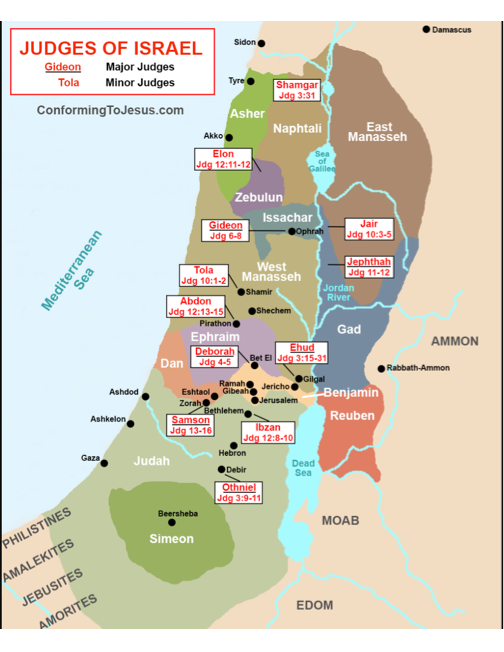
5 / To get a clearer ‘bird’s-eye’ view of the Judges narrator’s writing plan [structure] for this book, this center section of these twelve judges’ biographies is further divided into two sections. Lesson 4 surveyed the first section [chs 3.7—5.31]. In that section are the stories of three major judges [Othniel, Ehud, Deborah/Barak] and one minor judge [Shamgar]. Now, in this second sub-section, we will again review the stories of another three major judges [Gideon, Jephthah, Samson] and another five minor judges [Tola, Jair, Ibzan, Elon, Abdon]. The total number of judges [12] may also be an intentional indicator by the narrator that all twelve tribes of Israel were participants in this wholesale apostacy from Yahweh…
6 / And so, as you read through the Book of Judges, here is the order you will follow [Major / Minor]:
- Othniel (1st major judge—tribe of Judah) [3.7-11]
- Ehud (2nd major judge—tribe of Benjamin) [3.12-30]
- Shamgar (1st minor judge—tribe unknown) [3.31]
- Deborah/Barak (3rd major judge—tribe of Ephraim) [4.1—5.31]
- Gideon (4th major judge—tribe of Manasseh) [6.1—8.35]
- Abimelech, apostate ‘king’ [9.1-57]
- Tola (2nd minor judge—tribe of Issachar) [10.1-2]
- Jair (3rd minor judge—tribe of Gilead-Manasseh) [10.3-5]
- Jephthah (5th major judge—tribe of Gilead-Manasseh) [10.6—12.7]
- Ibzan (4th minor judge—tribe of Judah?) [12.8-10]
- Elon (5th minor judge—tribe of Zebulun) [12.11-12]
- Abdon (6th minor judge—tribe of Ephraim) [12.13-15]
- Samson (6th major judge—tribe of Dan) [13.1—16.31]
II | chs 6-8 | Gideon / 4th major judge [see Hebrews 11.32]
1 / “The people of Israel did what was evil in the sight of The LORD…” is the opening line of this second sub-section of the twelve judges—corresponding with the first sub-section in ch 3.7.
2 / The oppressors during the judgeship of Gideon were the Midianites along with numerous allies from the Amalekites and the people of the east [ch 6.3]. Several times throughout this narrative, we are told that they invaded Israel with vast hordes of armies and camels [chs 6.5; 7.12]. Their oppression consisted of ravaging the crops and countryside of everything that was edible, leaving the Israelites without food. This went on for seven years. In fact, when the angel of The LORD appeared to Gideon to call him to serve as Israel’s deliverer, he was hiding down in the winepress pit, beating out some wheat he had salvaged. Gideon was a reluctant judge from the get-go. He doubted himself every step of the way. But Yahweh worked wonder after wonder for him to witness—just so he would be sure that when deliverance did come, it would be the work of Yahweh: “But the Spirit of The LORD clothed Gideon…” [6.34].
3 / Gideon was the son of Joah; and just to show you how far Israel had apostatized from Yahweh, Gideon’s first commission from The LORD was to destroy his own father’s altars and images of Baal and Asherah that he had established for community worship. But The LORD was calling Gideon to overthrow the Midianites and lead them back to Yahweh. In spite of all his flaws, faults, and foibles—and his repeated lack of faith and trusting Yahweh [as we shall see], he is still listed in the Hall of Faith in Hebrews 11.32.
4 / Gideon is best known to us for his ‘fleece’ signs that he asked Yahweh to show him. We still talk about asking for some kind of specific sign to discern God’s will as ‘putting out a fleece’ [ch 6.36-40]. Gideon is also well-known for his military conquests with only ‘Gideon’s 300’ [ch 7.1-8]. That number of only 300 soldiers was whittled down from the original 32,000. 22,000 were disqualified under the first test, and then the remaining 9,700 were disqualified in the second test. This was to show Gideon that any victory that ‘he’ won against the innumerable hordes of Midianites would be Yahweh’s doing! In fact, even these 300 men went to war against the Midianites without swords of their own! The only weapons they ‘fought’ with were clay jars, the torches they concealed in the jars, and trumpets they would blow at Gideon’s command. Their shout of their military might and power was “For The LORD and for Gideon!” and “A sword for The LORD and for Gideon!” [ch 7.18, 20]. The way they defeated the Midianites was that The LORD turned the Midianites against themselves—and they killed each other! “When they blew the 300 trumpets, The LORD set every man’s sword against his comrade and against all the army” [ch 7.22]. When Yahweh turned them upon themselves—they self-defeated!
5 / There is a sad ending to Gideon’s story, though, because at the end of his own life, he established himself as a spiritual cult-leader of a sort and led Israel away from Yahweh during his own latter lifetime. “And Gideon made an ephod [a counterfeit religious vestment/garb] … and put it in his city, in Ophrah. And all Israel whored after it there, and it became a snare to Gideon and to his family” [ch 7.27].
III | ch 9 | Abimelech / renegade/rogue ‘king wannabe’
1 / Abimelech’s story begins at the end of Gideon’s. Abimelech was the son of Gideon’s concubine in Shechem [NOTE: Gideon as also called Jerubbaal, chs 7.1; 8.29; 9.1]. As soon as Gideon died, the people of Israel once again turned from Yahweh to serve their local false gods [ch 8.33-35]. This son of Gideon, Abimelech, took advantage of the apostacy of Israel where he lived and persuaded his hometown folks in Shechem to anoint him as their ‘king’ rather than serve the other seventy sons of Gideon [ch 8.29-32]. They were all too glad to follow Abimelech. NOTE: the Judges narrator highlights this self-appointed ‘kingship’ of Abimelech to show the stark contrast to the over-all theme of the book: “There was no king in Israel. Everyone did what was right in his own eyes” [ch 21.25]. What we must keep in mind—not only here, but all throughout this book—is that there was a King in Israel all along. Yahweh was their King! It’s just that they would not recognize or obey the King they had! They rejected and apostatized from their True, Righteous, and Rightful King! This prepares us for the need of a Messianic King!
2 / At any rate, Abimelech ruled over Israel three years [ch 9.22], until The LORD sent an evil spirit between Abimelech and the leaders of Shechem, and the leaders of Shechem dealt treacherously with Abimelech…[ch 9.23]. They betrayed Abimelech. This, too, was from The LORD to avenge the blood of Gideon’s seventy sons whom Abimelech had executed. In the series of a civil war battles that ensued, Abimelech was killed when a lone woman dropped a millstone from the roof of a tower where the inhabitants of Thebez had fled when Abimelech besieged it. That was the end of Abimelech and his story.
IV | ch 10.1-5 | Tola and Jair / 2nd and 3rd minor judges
These two minor judges are recorded in these five verses. Tola was from the tribe of Issachar. He judged Israel twenty-three years, and he died. Jair was a Gileadite from the tribe of Manasseh. He judged Israel in his locale for twenty-two years, then he died. He does appear to be quite a figure among his people since he was known for having thirty sons who rode on thirty donkeys, and they had thirty cities. And the narrator notes that Jair’s legacy and lore continued for generations following, even to this day [10.4].
V | chs 10.6—12.7 | Jephthah / 5th major judge [see Hebrews 11.32]
1 / Jephthah was another Gileadite [Gilead was the inheritance of the half-tribe of Manasseh on the east side of Jordan]. Except that, Jephthah was an illegitimate son of his father Gilead with a prostitute [11.1-3]. So his brothers expelled him from their inheritance, and he went and settled in a secluded area. Then when they came under servitude and subjugation, they sent to him and asked him to deliver them. Again, Jephthah is the third judge of whom it is said: “Then the Spirit of The LORD was upon [him]…” [11.29].
2 / The Ammonites were the oppressors in his day. The Ammonites contended with Jephthah to give them back the land that Moses had conquered enroute to Canaan. These were the kingdoms of Edom, Moab, and especially of Sihon king of the Amorites. Jephthah just repeats back to them the stories of those days when Yahweh delivered these kingdoms and lands into the hands of Moses and the Israelites [11.12-28].
3 / Jephthah is well-known for the vow he made to Yahweh—“If you will give the Ammonites into my hand, then whatever comes out from the doors of my house to meet me when I return in peace from the Ammonites shall be The LORD’s, and I will offer it up for a burnt offering” [11.30-31]. The LORD did give the Ammonites into his hand…and to his dismay, who was first to run to meet him when he returned home—but his daughter, his only child! So, scholars have debated ever since: did Jephthah actually slaughter his daughter and offer her as a burnt sacrifice? Or was she devoted to The LORD as an unmarried virgin servant for the rest of her days? [11.34-40]. [See Deuteronomy 12.31; 18.9-12]
VI | ch 12.8-15 | Ibzan, Elon, and Abdon / 4th, 5th, and 6th minor judges
Their three stories are briefly related in the narrative…
VII | chs 13-16 | Samson / 6th major judge [see Hebrews 11.32]
1 / Of course, Samson, a Danite, is best known for his super-human strength [as well as his super-weakness for forbidden women, and his rebellious self-will]. And, no doubt, Samson had the physical physique through which Yahweh would work. But, for the fourth time, the Judges narrator credits Yahweh with all of Samson’s victories: “And the Spirit of The LORD began to stir him…” [13.25; 14.6,19; 15.14]. Samson’s strength was in his availability and usability of Yahweh to carry out His judgments of vengeance against the Philistines [chs 13.5, 7; 14.4; 16.28-30]. His ‘Nazirite’ dedication, with all its distinctive lifestyle exclusions [13.4-5, 7, 14; 16.17] designated Samson as an agent through which Yahweh would work His salvation purposes and power. ‘Nazirite’ means ‘devoted, consecrated.’ But, without the immediate Presence of Yahweh, Samson’s strength was no more than any other man’s [16.17, 20, 22-30].
2 / Samson repeatedly violated his Nazirite vows throughout his lifetime, but in the end, he repented of all his failures and called upon Yahweh one last time to fulfill His purposes through him…which He did!